
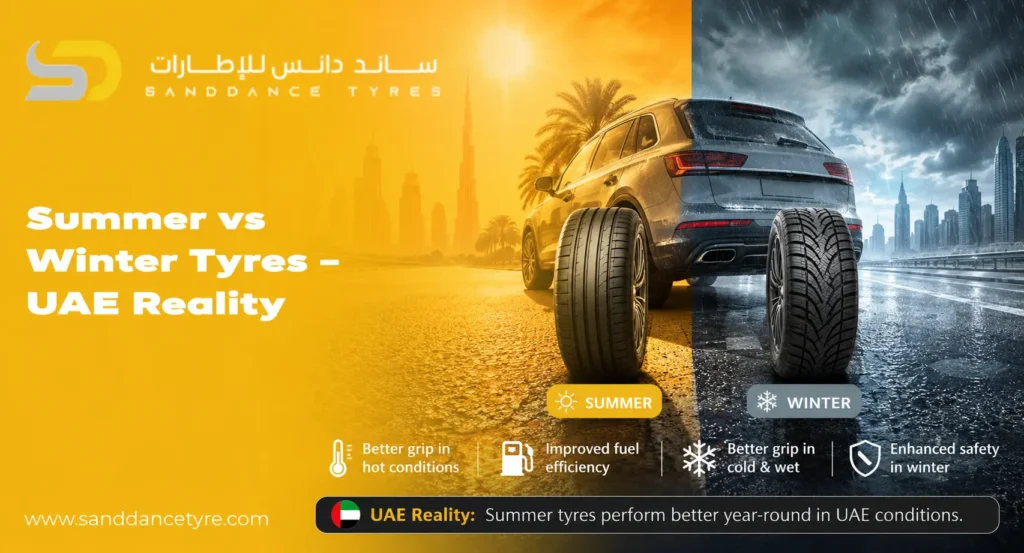
If you’ve ever searched “summer vs winter tyres” and landed on articles written for drivers in Germany or Canada, you already know how frustrating it is. The advice just doesn’t apply here. The UAE is a completely different story — scorching tarmac, extreme heat, occasional mountain fog in Ras Al Khaimah, and yes, the rare desert sandstorm. So let’s have an honest, no-nonsense conversation about what those tyre categories actually mean for someone living and driving in the Emirates.
Spoiler: the answer might surprise you. But understanding it properly could save your tyres, your fuel economy, and quite possibly your life.
First, Let’s Actually Define What Summer and Winter Tyres Are
Before we dive into the UAE-specific picture, it’s worth being clear on what these two tyre types were originally designed for — because the names are a bit misleading when you’re reading them from a country where “winter” means 22°C.
What Are Summer Tyres?
Summer tyres are designed for warm to hot road conditions, typically above 7°C. They use a harder rubber compound that stays firm and grippy on hot, dry tarmac. The tread pattern is relatively simple — wide grooves and a large contact patch that gives you better cornering grip and shorter braking distances on dry roads. They also perform well in warm rain, which is exactly the kind of driving most UAE residents do.
Here’s the key thing: the rubber compound in summer tyres doesn’t soften excessively in heat, which means they maintain their shape and performance even when the road temperature climbs above 50°C — a very real scenario on UAE motorways during July and August.
What Are Winter Tyres?
Winter tyres use a softer rubber compound that stays flexible in temperatures below 7°C. They have deep, intricate tread patterns with tiny grooves called “sipes” that bite into snow and ice. That soft compound is their superpower in cold conditions — but it’s also their weakness in heat. In hot weather, winter tyre rubber becomes too soft, wears rapidly, and actually reduces grip on dry roads rather than improving it.
Important: Using winter tyres in UAE summer conditions isn’t just wasteful — it’s genuinely less safe. The soft compound will overheat, wear unevenly, and grip poorly on the hot, dry roads that make up nearly 99% of UAE driving.
Summer vs Winter Tyres UAE: What the Local Climate Actually Demands
Let’s talk numbers for a moment. Average daytime temperatures in Dubai from May to September regularly exceed 40°C in the air. Road surface temperatures? Those can hit 60°C to 70°C in peak summer. That is the environment your tyres are dealing with every single day.
The UAE Has Almost No “Winter Tyre Weather”
The classic recommendation in Europe is to switch to winter tyres when temperatures consistently drop below 7°C. In the UAE, that practically never happens. Even in January, the coldest month, Dubai averages around 19°C. The northern emirates — Fujairah, Ras Al Khaimah, parts of the Hajar Mountains — do get cooler, sometimes dipping to 10–14°C at night in December and January. But this is still well above the temperature threshold where winter tyres would give you a meaningful advantage.
For the vast majority of UAE drivers, summer tyres (or more precisely, high-quality all-season tyres designed for hot climates) are what you should be using year-round. Full stop.
What About Drivers in the Northern Emirates or Near the Mountains?
This is where the conversation gets a little more interesting. If you regularly drive through Jebel Jais or mountain roads in Ras Al Khaimah, you’ll occasionally encounter cold, wet, or even frost-like conditions in winter. In these specific scenarios, a quality all-season tyre makes more sense than a pure summer tyre. But even then, dedicated winter tyres are overkill and impractical for a vehicle that also covers Abu Dhabi motorways in the summer.
Quick Comparison: Which Tyre Type for UAE Conditions?
| Condition | Summer Tyre | Winter Tyre | All-Season (Heat-Rated) |
| Dubai city driving (30–45°C) | ✅ Excellent | ❌ Dangerous | ✅ Good |
| UAE motorway at speed | ✅ Excellent | ❌ Poor grip, fast wear | ✅ Good |
| Wet roads (summer rain) | ✅ Good | ⚠️ Soft, less stable | ✅ Good |
| Mountain roads (Jebel Jais, winter) | ⚠️ Adequate | ✅ Better traction | ✅ Best compromise |
| Sandy desert tracks (off-road) | ❌ Not designed for this | ❌ Not designed for this | ⚠️ Depends on rating |
Why This Matters More Than You Might Think
People often treat tyre choices as a technical detail — something to leave to a mechanic. But in the UAE, where speeds on Sheikh Zayed Road regularly reach 120 km/h and higher, having the wrong tyre compound under your car is not a trivial matter. Stopping distances increase. Heat buildup accelerates tyre degradation. Blowouts become more likely.
Heat and Tyre Pressure: A UAE-Specific Problem
One thing that catches many UAE residents off guard is how dramatically tyre pressure changes with temperature. For every 10°C rise in ambient temperature, tyre pressure increases by roughly 1 PSI. So if you inflate your tyres to the correct pressure in an air-conditioned car park in the morning, by the time you’ve driven on sun-baked tarmac for 20 minutes, the pressure inside those tyres has climbed considerably. Summer tyres are engineered to handle this. Winter tyres are not.
Tread Wear in the UAE Heat
Premium summer tyres from reputable brands are built to last even under extreme thermal stress. If you’re using budget winter tyres imported from European markets, you’ll often find they wear out much sooner than expected in the UAE climate. This is a false economy — you think you’re saving money, but you’re replacing tyres far more frequently and compromising safety in the process.
For trusted performance in the UAE heat, brands like BFGoodrich Tyres have built a strong reputation. Their All-Terrain and street-focused ranges are specifically designed to handle thermal stress well, which is exactly what UAE roads demand.
All-Season Tyres: The Practical Middle Ground for Most UAE Drivers
If summer tyres are best for heat and winter tyres are built for cold, where does that leave someone in the UAE who occasionally visits cooler climates, or who drives frequently in the northern emirates in January? All-season tyres — sometimes called “four-season” tyres — are designed to be a competent compromise across a wide temperature range.
But Not All All-Season Tyres Are Equal in UAE Conditions
This is a really important point that gets glossed over in generic tyre content. An all-season tyre made for the North American or European market may use a compound that’s softer than an ideal UAE tyre. The “season” in question is designed around climates that have proper cold winters. What you want in the UAE is an all-season tyre that is heat-rated for sustained high-temperature performance.
When you’re looking to buy tyres online in Dubai, pay close attention to the temperature rating on the tyre’s sidewall. Look for a “B” or ideally an “A” temperature rating — these indicate the tyre’s ability to dissipate heat safely at high speeds. This is the single most important spec for UAE driving and it’s often overlooked.
Speed Ratings Also Matter
UAE roads are fast. If your tyres aren’t rated for sustained high-speed driving, they will build up dangerous levels of internal heat. Look for speed ratings of “H” (210 km/h), “V” (240 km/h), or “W” (270 km/h) depending on your vehicle. Never go below what your car manufacturer recommends, and in the UAE, it generally makes sense to match or exceed it.
Practical Tyre Care in the UAE: What Actually Makes a Difference
Getting the right type of tyre is only part of the equation. How you maintain them in UAE conditions matters just as much.
Check Pressure More Frequently
Given the temperature swings between morning and afternoon — especially in summer — checking your tyre pressure once a month isn’t enough. Make it a habit every two weeks. Always check cold pressure, ideally in the morning before you’ve driven. Don’t bleed air from hot tyres; let them cool first and then check again.
Don’t Ignore Tyre Age
UV radiation in the UAE is intense year-round. Even if your tyre tread looks perfectly fine, UV exposure causes the rubber to dry out and crack internally. As a general rule, no tyre over five to six years old should be on a UAE vehicle, regardless of how much tread it has left. Check the four-digit DOT code on the sidewall — the last four digits tell you the week and year of manufacture.
Keep an Eye on Your AC — It Affects Tyre Life Too
This one surprises people. A failing car air conditioning system forces your engine to work harder, which increases underbonnet temperatures and can indirectly affect how quickly tyres degrade in stop-and-go city traffic. If your AC is blowing warm or struggling, getting a car AC repair service is worth doing not just for comfort, but for overall vehicle health.
Rotate Your Tyres Every 8,000–10,000 km
UAE roads are hard on tyres, and the wear patterns can be uneven — particularly if you spend a lot of time on motorways. Front tyres wear faster due to steering forces. Regular rotation extends the life of your full set and keeps handling balanced.
What About Off-Road and Desert Driving?
Summer vs winter tyres is a European framework. In the UAE, there’s a third category that’s highly relevant for a significant portion of drivers: off-road and all-terrain tyres for desert use.
Summer Tyres and Desert Tracks Don’t Mix
If you’re taking your SUV to the dunes in Al Ain or heading off-road in the Liwa desert, summer road tyres are simply not built for it. They’ll struggle with traction in soft sand and you risk sidewall damage from rocks and debris. All-terrain tyres designed for mixed on/off-road use are the correct choice here. They need to handle highway speeds as well as unpaved desert tracks — a demanding combination that only proper AT-rated tyres can manage safely.
Tyre Deflation for Sand — A Quick Note
Experienced desert drivers in the UAE regularly deflate tyres to around 18–22 PSI before heading onto soft sand. This increases the tyre’s footprint, reduces sinkage, and dramatically improves traction. This technique only works safely with tyres that have robust enough sidewalls to handle the low pressure without folding — another reason purpose-built all-terrain tyres matter for off-road use here.
The Bottom Line: Summer vs Winter Tyres in the UAE
Let’s bring it all together cleanly.
For the vast majority of UAE drivers — people living in Dubai, Abu Dhabi, Sharjah, or any of the coastal cities — dedicated summer tyres or high-quality heat-rated all-season tyres are what you need, year-round. Winter tyres are actively harmful in UAE conditions and should not be used here.
For drivers who regularly travel mountain roads in the northern emirates or who visit cooler parts of the region in January and February, a quality all-season tyre with a high temperature rating is the most practical choice — combining enough cold-weather competence for those occasional cool drives with the heat resistance needed for everyday UAE roads.
For off-road enthusiasts and adventure drivers, all-terrain tyres are their own category entirely — and that’s a conversation worth having with a specialist who knows the UAE terrain.
The single best thing you can do for your safety on UAE roads is to match your tyre compound to the climate you actually drive in — not the climate on the back of a European tyre brochure.
When you’re ready to make a decision, working with a trusted local tyre specialist who understands UAE road conditions is far more valuable than general online advice. They can look at your vehicle, your driving profile, and recommend something that actually fits your life here.
Frequently Asked Questions
Q: Do I need to switch between summer and winter tyres in the UAE?
No. The UAE climate does not have true winter conditions. Temperatures rarely drop to the 7°C threshold where winter tyres begin to outperform summer tyres. For virtually all UAE drivers, high-quality summer tyres or heat-rated all-season tyres are appropriate year-round, and using winter tyres in UAE heat is actually unsafe.
Q: Are winter tyres dangerous in the UAE summer?
Yes, they can be. Winter tyres use a softer rubber compound designed to remain flexible in cold temperatures. In the extreme heat of UAE summers, this soft compound becomes too pliable, wears down very quickly, and reduces dry-road grip. They are the wrong tool for the job and can increase stopping distances.
Q: What is the best tyre type for Dubai roads?
For most Dubai drivers, premium summer tyres or high-temperature-rated all-season tyres are ideal. Look for tyres with an “A” or “B” temperature rating on the sidewall, and ensure the speed rating matches or exceeds your vehicle’s requirements. Brands with proven heat performance in the Middle East market are a good starting point.
Q: How often should I replace my tyres in the UAE?
Due to the intense heat, UV exposure, and road conditions, tyres in the UAE typically need replacing more frequently than in cooler climates. As a guideline, replace tyres every 40,000–50,000 km or every five to six years — whichever comes first — regardless of visible tread depth. UV degradation can cause internal compound breakdown before the tread wears away.
Q: Can I use all-terrain tyres as daily drivers in UAE cities?
Yes, many UAE drivers do this successfully, especially those with SUVs who occasionally go off-road. All-terrain tyres designed for mixed use can handle motorway speeds and city driving while also being capable off-road. However, they typically have slightly higher road noise and may have marginally longer stopping distances on smooth tarmac compared to dedicated road tyres.
Q: How does UAE heat affect tyre pressure, and how should I manage it?
Heat significantly increases tyre pressure — roughly 1 PSI for every 10°C rise in temperature. Always check tyre pressure cold (before driving or after the car has been parked for several hours), ideally in the morning. Don’t deflate tyres that have been driven on in the heat, as the pressure will drop again once they cool. Check every two weeks rather than monthly, given UAE temperature extremes.