
If you’ve ever wondered whether your tyre speed rating really matters—yes, it absolutely does. A lower tyre speed rating than what your vehicle manufacturer recommends isn’t just a technical mismatch. It can affect your safety, your insurance, and the way your car handles on the road. Let’s break this down in plain language so you know exactly what’s at stake before you decide on the tyre shop.
Understanding Tyre Speed Ratings—What Do Those Letters Actually Mean?
Every tyre has a speed rating—a letter code that tells you the maximum sustained speed that tyre is designed to handle safely. You’ll usually find it as part of the tyre size code on your sidewall, something like 225/45R17 91W. That final letter — W in this case—is your speed rating.
Here’s a quick reference for the most common ones:
- T = up to 190 km/h
- H = up to 210 km/h
- V = up to 240 km/h
- W = up to 270 km/h
- Y = up to 300 km/h
Your car manufacturer picks a rating that suits the vehicle’s performance capability. Fitting a tyre with a lower speed rating means you’re putting rubber on your car that wasn’t engineered to keep up with it.
The Real Risks of Using a Lower Speed-Rated Tyre
Let’s be honest — most drivers in the UAE aren’t pushing their cars to 250 km/h on a daily commute. So why does it matter? The answer goes beyond raw top speed.
Heat Buildup and Tyre Failure
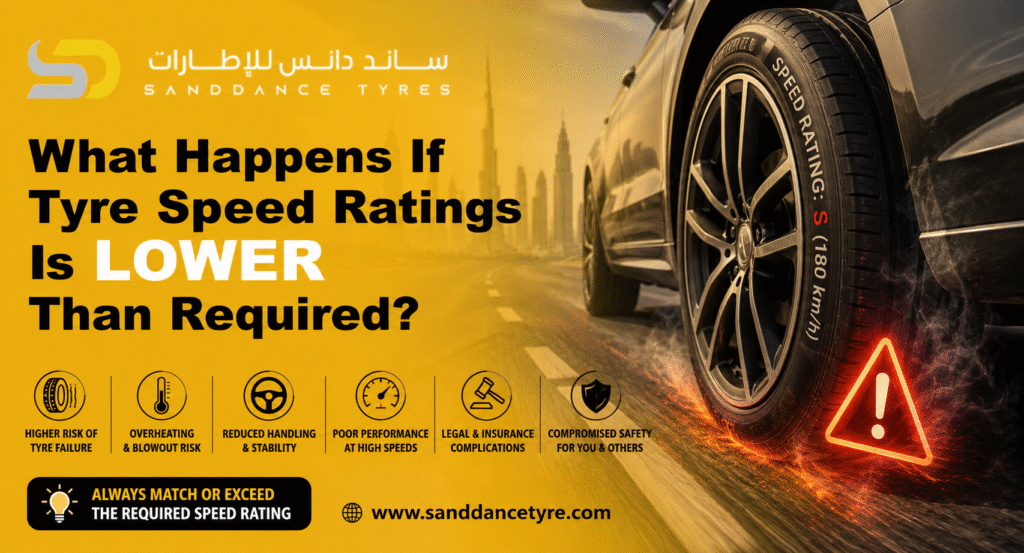
Speed ratings aren’t just about maximum velocity. They reflect the tyre’s ability to manage heat at sustained speeds. A lower-rated tyre generates more heat at high speeds because its construction — the rubber compound, internal structure, and ply design — isn’t built for the same thermal load. In the UAE’s already extreme heat, this is a genuine concern. Driving at 120 km/h on Sheikh Zayed Road in August with under-rated tyres can cause the tyre to soften, deform, or even blow out.
Reduced Handling and Braking Performance
Speed rating also relates to how a tyre grips the road under load. Lower-rated tyres tend to have softer constructions that flex more under high-speed cornering or sudden braking. If you’re driving a performance car or even a large SUV and need to brake hard, the difference in stopping distance can be significant — and dangerous.
Voided Insurance Cover
This one catches people off guard. If you’re involved in an accident and it’s discovered that your tyres don’t meet the manufacturer’s specification, your insurance provider may refuse to pay out. This applies both to the UAE’s mandatory third-party cover and comprehensive policies. Fitting non-compliant tyres is considered a modification that voids your cover under most standard policies.
Legal Implications During Inspections
In the UAE, vehicles undergo periodic RTA inspection. If your fitted tyres don’t match the required specification — including speed rating — your vehicle can fail the test. That means fines, delays, and the cost of replacing tyres you’ve already paid for.
Can You Ever Go Higher Than the Required Speed Rating?
Yes — and this is generally fine. Fitting a higher-rated tyre than required is acceptable in most cases and won’t cause safety problems. Some drivers deliberately choose higher-rated tyres because they tend to have stiffer, more responsive constructions that improve handling feel, even at legal speeds. The main trade-off is usually a slightly firmer ride and sometimes a higher price.
The critical rule is: never go lower. Always at or above the manufacturer’s minimum specification.
Why the UAE Climate Makes Speed Ratings Even More Important
Most tyre speed rating guidelines are written with European or North American climates in mind. In the UAE, ambient temperatures regularly exceed 45°C in summer. Road surface temperatures can hit 70°C or more. This dramatically accelerates the thermal stress that tyres experience — making the buffer provided by a correctly-rated or higher-rated tyre genuinely important, even if you’re not a fast driver.
If you’re looking for expert guidance on which tyres suit both your vehicle and the local climate, the team at Sand Dance Tyre has years of hands-on experience helping UAE drivers make the right call. You can explore their full range of services at
If you’re looking for expert guidance on which tyres suit both your vehicle and the local climate, the team at Sand Dance Tyre has years of hands-on experience helping UAE drivers make the right call.
How to Check Your Required Speed Rating
Not sure what your car needs? Here are the most reliable ways to find out:
- Check the sticker inside your driver’s door jamb — most cars have the recommended tyre size and load/speed ratings listed there.
- Consult your owner’s manual — the tyre section will specify the exact requirements.
- Look at your existing tyres — if they’re OEM fitment, the rating is already correct.
- Ask a qualified tyre technician — a good shop will check this for you before fitting anything.
What If You’ve Already Fitted Lower-Rated Tyres?
If you’ve already fitted tyres that are below the required speed rating, the sensible move is to replace them as soon as possible — especially if you drive regularly on UAE motorways. Don’t wait for a problem. Tyre failure on a high-speed road is one of the most dangerous situations a driver can face.
And if your car has any other mechanical issues contributing to uneven tyre wear or heat buildup — like a faulty cooling system affecting underbody temperatures — it’s worth getting a full check done. Sand Dance Tyre also offers
And if your car has any other mechanical issues contributing to uneven tyre wear or heat buildup — like a faulty cooling system affecting underbody temperatures — it’s worth getting a full check done. Sand Dance Tyre also offers car AC repair service to make sure your vehicle is performing safely in all conditions.
Matching Load Index and Speed Rating Together
Speed rating always works alongside load index — the number that appears before the speed rating letter (e.g., the 91 in 225/45R17 91W). Both must meet or exceed the manufacturer’s requirement. You can’t compensate for a lower speed rating by choosing a higher load index. They’re separate specifications that address different aspects of tyre performance.
Does Driving Style Make a Difference?
Yes, but it doesn’t eliminate the risk. If you rarely leave urban areas and never exceed 80 km/h, the immediate risk of using a lower-rated tyre is reduced. But you’re still running non-compliant tyres from a legal and insurance standpoint, and you lose that safety margin for emergency situations — hard braking, sudden swerves, or unexpected high-speed situations on motorway on-ramps.
A Word on Budget Tyres and Speed Ratings
Some budget tyre brands offer lower speed ratings at lower prices. It can be tempting, especially when replacing all four tyres. But the speed rating isn’t a luxury feature — it’s a safety specification. If your vehicle requires H-rated or V-rated tyres, fit H-rated or V-rated tyres. There’s no meaningful saving worth the trade-off.
Customer Reviews
★★★★★ Khalid M., Dubai
I came in thinking any tyre would do the job. The team explained the speed rating difference clearly and showed me why my original choice was below spec for my car. Really appreciated the honesty. Won’t go anywhere else now.
★★★★★ Priya S., Sharjah
After a blowout on the highway, I learned the hard way about tyre ratings. Sand Dance Tyre sorted me out with the right fitment and took the time to explain exactly what went wrong. Knowledgeable and trustworthy staff.
★★★★☆ Mohammed A., Abu Dhabi
Good service and solid technical advice. They matched the correct speed rating for my SUV without trying to upsell me unnecessarily. Fair pricing and quick turnaround.
★★★★★ Laura B., Al Ain
Didn’t realise my previous garage had fitted the wrong speed-rated tyres. Sand Dance picked it up immediately during a check. Fixed the issue same day. The kind of attention to detail you want from a tyre shop.
Final Thoughts
Tyre speed ratings exist for a reason. They’re not marketing numbers or upsell tactics — they’re engineering specifications that define how safely a tyre performs at the speeds your vehicle can reach. In the UAE’s high-temperature, high-speed driving environment, fitting the correct rating isn’t optional. It’s one of the most important tyre decisions you’ll make.
When in doubt, talk to a qualified tyre professional. The right advice up front is always cheaper than the alternative.