
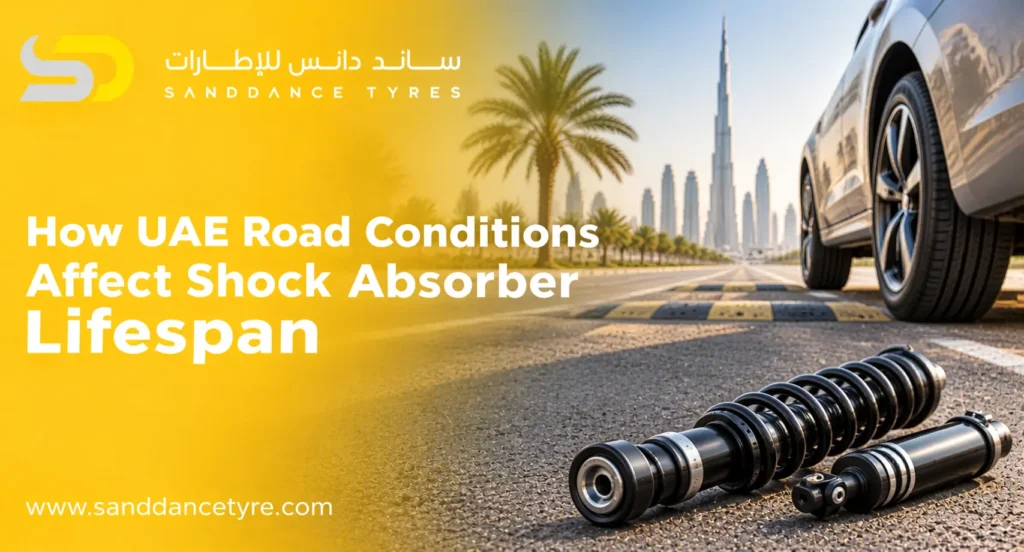
On 5 August 2026 the National Centre of Meteorology logged 51.2°C, the UAE’s highest reading of the summer. On the road it felt even worse. With the air near 50°C, sunlit asphalt can reach 80–90°C around midday.
Your tyres feel that heat first, and the shocks above them feel it next.
That’s why shock absorber lifespan UAE drivers actually get tends to fall short of the numbers on the box, and why car suspension problems in Dubai usually creep in quietly. Shocks fade so slowly that most of us get used to a worse ride without noticing.
Here’s what heat, dust, speed bumps, fast highways and heavy loads do to them, how to catch the damage early, and what a proper check involves. It matters for braking, stability and tyre life, not only comfort. Your car can feel normal and still be riding on shocks that are well past their best.
What Shock Absorbers Actually Do, and How Long They Should Last
Shocks don’t hold your car up. The springs do that. A shock’s job is to calm the springs down, so the tyres stay pressed against the road after a bump instead of bouncing off it. That keeps braking and cornering steady.
Parts makers usually quote somewhere between 50,000 and 100,000 miles, which is roughly 80,000 to 160,000 km. Treat that as a global guide, not a UAE figure. Even the makers say the real number depends on driving conditions, road quality and how the car is used.
Workshops go by condition more than mileage. A leak, a failed bounce test or a ride that’s visibly gone soft tells you more than the odometer does. So the shock absorber lifespan UAE drivers should plan around is really a question of where you drive, and how hard, as much as how far.
How UAE Road Conditions Shorten Shock Absorber Lifespan
Potholes aren’t really the problem here. Most UAE roads are smooth, which is exactly why drivers are surprised when their shocks tire early. It’s a mix of conditions, and each one chips away at a different part of the shock.
Extreme Heat and Hot Asphalt
Local weather reports put sunlit asphalt at roughly 70–75°C when the air reaches 45°C, and the Emirates Astronomical Society’s chairman, Ibrahim Al Jarwan, has said road surfaces can run close to 20°C hotter than the air. Estimates vary, but the direction is clear.
Inside the shock, heat thins the damping oil, hardens rubber bushings and mounts until they turn brittle, and wears seals until they start to leak. You’ll notice a floaty ride, extra bounce, and squeaks or rattles. None of this happens overnight. It builds up, summer after summer.
Sand, Dust and Weekend Dune Runs
Fine grit settles on the piston rod and gets dragged across the seal on every stroke. Sand and road dirt are well-known causes of worn rod seals, and worn seals mean oil leaks. Weekend dune or off-road runs pile on repeated heavy loading, so it’s smart to have the shocks looked at after a trip. Watch for an oily, dusty film on the shock body, clunks, or a car that stops feeling controlled.
Speed Bumps, Roadworks and Post-Rain Damage
Smooth highways don’t tell the whole story. Dense city traffic means constant speed bumps, hard braking and tight turns. Humps in residential streets, car parks and compounds add up, and hitting them too fast is the biggest cause you can actually avoid. Roadworks and patched surfaces play a part too, and heavy downpours or flooding can leave potholes behind. If your car knocks over humps, rides harsher than before or pulls to one side after a hard hit, the suspension took a beating.
Fast Highways, Heavy Loads and Stop-Start Traffic
Long, fast cruising keeps the dampers working and heating up for hours. Big SUVs, a full family load, roof racks and towing add strain, and workshop guides count heavy loads and rough use as reasons the lifespan range shrinks. Stop-start commuting adds constant weight transfer under braking. The giveaways are nose-dive when you brake and a floaty feel at speed.
Humidity and Rain
Humidity tends to build from mid-August through late September, and heat plus humidity speeds up corrosion. Mounts, shock bodies and bolts can rust, and water from a downpour mixed with dust forms a gritty paste around the rod. Look for rust staining, creaks, and bolts that refuse to budge at service time.
Car Suspension Problems in Dubai: Warning Signs of Worn Shock Absorbers
Because the wear is so gradual, you need a few quick checks rather than a gut feeling.
Signs You Can Check Yourself
- The car keeps bouncing after a bump
- The nose dips hard when you brake
- The ride feels floaty, then suddenly harsh
- Knocking or clunking over bumps
- Uneven tread wear on the tyres
- Oil running down the shock body
- Longer stopping distances or steering vibration
On the oil point, a light film is normal and even helps the rod seal. Wet, dripping streaks are not, so look on a clean, dry shock.
For a bounce test, press down firmly on each corner and let go. A healthy shock settles within a rebound or two, though the test can miss worn struts, so a pass isn’t a clean bill of health. Two or more signs together mean it’s time to book an inspection.
What Happens If You Ignore Worn Shocks
Worn shocks wear tyres out faster, and a tyre shop Dubai technician can usually spot the uneven tread that gives it away. They also overload nearby parts like bushings and mounts, so one fault turns into several. Longer stopping distances and less stability at highway speed make this a safety issue, not just a comfort one. Catching it early is usually cheaper than replacing tyres and other parts later.
How to Extend Shock Absorber Lifespan in the UAE
You can’t stop the sun, but a few habits slow the wear.
- Slow down for speed humps and roadworks instead of braking over them.
- Don’t overload the car, and take off roof racks and spare weight you don’t need.
- Park in shade or covered parking when you can, so rubber and seals don’t bake.
- Keep tyre pressure right, since soft tyres push extra stress into the suspension.
- After a desert or off-road drive, gently wash off sand and mud and check the dust boots.
- Replace shocks in pairs on the same axle, and get the alignment checked afterwards.
- Book a check before summer, and another after any hard impact.
None of it is dramatic. The speed-hump habit alone is probably the easiest win, since hitting them too fast is the main avoidable cause of shock damage.
Shock Absorber Replacement in Dubai: What to Expect and What Affects the Cost
Spotted a few warning signs? Here’s how the next step usually goes.
What a Suspension Inspection Involves
A good inspection starts with a road test and a visual check of the shocks or struts, springs, bushings, mounts and ball joints. You should get written findings that split “replace now” from “monitor”. Shocks go in axle pairs, then an alignment check. A workshop offering car suspension repair Dubai should explain each finding. Still choosing a workshop? This guide to a reliable suspension service Dubai can help.
What Affects Suspension Repair Cost in Dubai
There’s no single price. The bill depends on your vehicle and its suspension service Dubai design (standard, adaptive or air), front or rear, whether other worn parts need attention, part quality, labour time, the alignment and VAT. Prices swing too widely to quote a number here, so ask for a written quote after the inspection.
Final Thoughts
Heat and hot asphalt, sand and dust, speed bumps, fast driving and heavy loads each wear shocks down in a different way, and the decline is slow enough to miss. That’s the real story behind Shock absorber replacement Dubai drivers deal with. There’s no single culprit, only small hits stacking up season after season until a worse ride starts to feel normal.
Four things worth remembering:
- Judge your shocks by condition, not mileage alone. A leak or a ride gone soft matters more than the odometer.
- Know the signs: continued bouncing, nose-dive under braking, clunks, oil on the shock body and uneven tyre wear.
- Slow down for humps, park in shade and don’t overload the car. Small habits add real life to a shock.
- Get your suspension inspected at least once a year, and always before summer.
Think of shocks as a safety component rather than a comfort upgrade. They keep your tyres planted when you brake hard or swerve to avoid something, and that’s not the moment to find out they’ve given up. A pre-summer check is the simplest way to avoid bigger tyre and suspension bills down the line.
If something has felt off lately, a suspension check is a sensible place to start.
Frequently Asked Questions
Q 1: How long do shock absorbers last in the UAE?
Parts makers quote roughly 50,000–100,000 miles (about 80,000–160,000 km), though it shifts with conditions and usage. In the UAE, heat, speed humps, dust and heavy loads can bring replacement sooner, so shock absorber lifespan UAE drivers see is decided by condition, not the odometer. Treat the range as a rough guide, not a promise.
Q 2: What are the signs of worn shock absorbers?
The five clearest signs are continued bouncing after bumps, nose-dive when braking, clunks over bumps, oily shock bodies and uneven tyre wear. Spot two or more and get them inspected. The full list, plus an easy bounce test, is in the warning signs section above.
Q 3: How much does suspension repair cost in Dubai?
There’s no single price. It depends on the vehicle type, whether the work is front or rear, which parts are needed, labour and alignment. After an inspection, ask for a written quote and check what it includes: labour, alignment and VAT. That way you can compare like with like instead of chasing a headline number.
Q 4: Does extreme heat damage shock absorbers?
Yes, gradually. Heat ages the damping oil, seals and rubber parts, and sun-baked asphalt adds to it. The damage is cumulative rather than sudden, so shade helps where you can find it, and a check before summer catches problems early. It won’t ruin a shock in a week, but years of it do add up.
Q 5: How often should I get my suspension checked in Dubai?
At least once a year, or roughly every 19,000 to 24,000 km (about 12,000 to 15,000 miles), is the usual workshop guidance. It’s general guidance rather than an official standard. Go sooner if you drive off-road often, carry heavy loads or have just hit something hard. A pre-summer check makes an easy rule of thumb to remember.