
Written by the Sand Dance Tyre Expert Team — Dubai, UAE. Over 15 years of tyre servicing experience across Dubai, Sharjah, and Abu Dhabi. Our technicians work daily with vehicles in extreme UAE heat conditions.
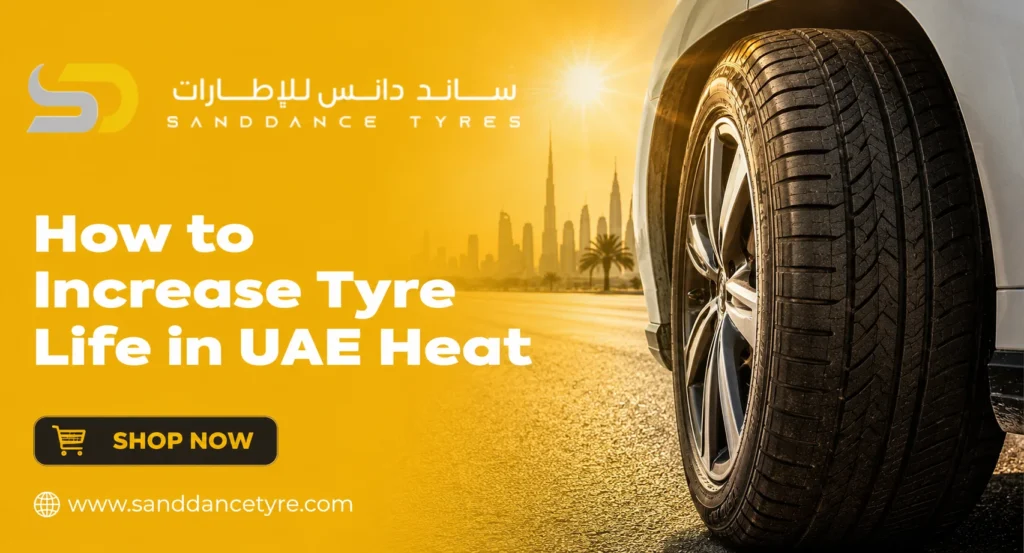
If you live in the UAE, you already know summer here is no joke. Temperatures that push past 45°C in the shade and tarmac that can hit 70°C or more under the midday sun don’t just make your commute uncomfortable. They are quietly destroying your tyres faster than almost anything else. Knowing how to increase tyre life in UAE heat is not just about saving money. It is genuinely about staying safe on the road.
In this guide, we’ll walk you through practical, proven steps you can start using right away—whether you’re driving a family SUV on Sheikh Zayed Road or navigating the busy lanes of Deira. Let’s get into it.
Why UAE Heat Is So Hard on Your Tyres
Before we talk about solutions, it helps to understand the problem. Tyre rubber is a compound that reacts to temperature. The hotter it gets, the more the rubber softens, expands, and — over time — breaks down. In the UAE, your tyres face a combination of stressors that you simply won’t find in most other parts of the world:
- Extreme road surface temperatures — UAE tarmac can reach 60–75°C in peak summer
- Ozone exposure — dry desert air is high in ozone, which causes sidewall cracking
- High-speed highway driving — frequent long stretches at 120 km/h or above generate serious heat friction
- Stop-start city traffic — alternating between full braking and acceleration accelerates tread wear unevenly
- UV radiation — year-round intense sun exposure oxidises and hardens the rubber surface
The result? Tyres in the UAE often wear out significantly faster than the manufacturer’s estimated lifespan — sometimes in half the expected time — if they’re not properly maintained.
Quick Fact: A tyre that might last 50,000 km in a temperate European climate could wear out in 25,000–30,000 km under UAE conditions without proper care.
1. Keep Tyre Pressure in Check — Every Week
Why Tyre Pressure Matters More in the UAE
This is the single most important thing you can do to protect your tyres — and it costs nothing except a couple of minutes of your time. Heat causes the air inside your tyres to expand. For every 10°C rise in ambient temperature, tyre pressure increases by roughly 1–2 PSI. On a Dubai summer afternoon, that adds up fast.
Both overinflated and underinflated tyres are dangerous. Overinflation creates a smaller contact patch with the road, causing uneven centre wear and a harsher ride. Underinflation is arguably worse — it causes the tyre sidewalls to flex excessively, generating internal heat buildup that can lead to blowouts. In a UAE summer, a blowout at highway speed is a life-threatening situation.
When and How to Check Your Tyre Pressure
Always check the pressure in the morning before driving, when the tyre is cold. Your vehicle’s recommended PSI is printed on the sticker inside the driver’s door jamb or in your owner’s manual. Don’t adjust pressure based on a reading taken after a long drive—the heat will give you a falsely high reading.
In UAE summer, we recommend checking at least once a week. Consider investing in a quality digital tyre pressure gauge—they’re inexpensive and far more accurate than forecourt gauges.
Pro Tip: Some drivers switch to nitrogen instead of regular air for tyre inflation. Nitrogen expands less with heat changes, providing more stable pressure in hot conditions — worth considering if you do a lot of highway driving in summer.
2. Rotate Your Tyres Regularly
Uneven Wear Is the Enemy of Tyre Life in UAE Heat
Front tyres and rear tyres wear differently. Front tyres carry the weight of the engine and handle steering, so they typically wear faster on the outer edges. Rear tyres on rear-wheel-drive vehicles wear more in the center. If you leave the same tyre in the same position for too long—especially in UAE conditions—one tyre ends up doing more than its fair share of the work.
Regular rotation redistributes the work evenly across all four tyres. In the UAE, we recommend a rotation every 8,000–10,000 km. If you drive mainly on highways or do high mileage daily, lean towards the shorter interval.
Combine Rotation with a Wheel Alignment Check
UAE roads—particularly in older neighborhoods or near construction zones—can cause your wheel alignment to drift without you even noticing. Misalignment forces one edge of the tyre to bear most of the load, causing rapid and uneven wear. A quick alignment check every 10,000–15,000 km alongside your rotation can add thousands of kilometers to your tyre life.
3. Park Smart — Shade Is Your Tyre’s Best Friend
How Parking Affects Tyre Life in UAE Conditions
It might sound too simple to matter, but where you park has a surprisingly significant impact on how long your tyres last. In UAE summer, a car parked in direct sunlight will have tyres sitting on scorching tarmac while being baked from above by the sun simultaneously. This continuous heat cycle accelerates rubber degradation, promotes ozone cracking on the sidewalls, and causes the tyre compound to harden and become brittle over time.
Whenever possible, park in covered car parks, underground garages, or shaded areas. If outdoor parking is unavoidable, try to position your car so the tyres are not facing direct sunlight for prolonged periods. Some drivers even use tyre covers for long-term outdoor parking—a practical solution for vehicles that sit unused for weeks at a time.
Did You Know? Sidewall cracking (also called ozone cracking or weather checking) is much more common in dry, sunny climates like the UAE. While surface-level cracks may look minor, deep sidewall cracking compromises the structural integrity of the tyre and is a safety hazard.
4. Choose the Right Tyre for UAE Roads
Not All Tyres Are Built for Desert Heat
This is where a lot of UAE drivers unknowingly lose years of tyre life. Buying cheap, low-quality tyres might save you a few hundred dirhams upfront, but those tyres will degrade much faster in extreme heat, costing you more in the long run — and potentially compromising your safety.
When choosing tyres for UAE driving, look for:
- High heat resistance — tyres rated for sustained high-temperature performance
- High load index — especially important for SUVs and family vehicles carrying passengers in hot conditions
- High speed rating — suitable for UAE highway speeds (V, W, or Y rated tyres are common recommendations)
- Quality compound — premium brands engineer their rubber compounds specifically for heat stability
Why Premium Brands Make a Real Difference in UAE Heat
If you want a tyre that genuinely holds up in UAE conditions, don’t compromise on brand quality. BFGoodrich Tyres are a popular and well-regarded choice among UAE drivers — engineered with heat-resistant compounds and designed to perform reliably across a range of road conditions, from Dubai’s urban streets to long desert highway runs. When you’re spending hours on roads that can hit 70°C surface temperature, the quality of your tyre compound genuinely matters.
You can conveniently buy tyres online in Dubai and have them fitted at your nearest Sand Dance Tyre branch — no need to spend your weekend driving around comparing prices at different garages.
5. Drive Smoothly — Your Habits Matter More Than You Think
Aggressive Driving Accelerates Wear in Hot Conditions
The UAE’s wide roads and powerful cars make aggressive driving tempting. But hard acceleration, sharp braking, and fast cornering all generate significantly more heat at the tyre contact patch. In a climate where your tyres are already working in extreme heat, adding friction heat from aggressive driving habits is a recipe for accelerated wear — and potential failure.
Here are some simple driving adjustments that genuinely extend tyre life:
- Accelerate smoothly and progressively — avoid wheel spin from a standstill
- Brake early and gradually — this distributes braking heat more evenly
- Take corners at reasonable speeds — centrifugal force pushes tyre sidewalls hard in fast bends
- Maintain safe following distances — fewer emergency braking situations means less heat stress
- Avoid driving on road shoulders where tarmac conditions are often worse and temperatures even higher
Highway Driving Tips for UAE Summer
Long highway journeys in summer (Dubai to Abu Dhabi, for example) put sustained heat load on your tyres. For trips over 200 km in peak summer, it is worth stopping for 10–15 minutes to allow your tyres to cool down slightly. Check for any visible cuts, bulges, or abnormalities on the sidewalls during these stops.
6. Get Regular Professional Inspections
Don’t Wait for a Problem to Find You
In the UAE, many drivers only think about their tyres when something goes obviously wrong — a puncture, a vibration, or worse, a blowout. By that point, the damage is already done. Regular professional inspections catch small problems early, before they become expensive or dangerous.
A professional tyre technician will check:
- Tread depth — UAE law requires a minimum of 1.6mm, but replacing at 3mm is much safer
- Sidewall condition — checking for cracking, bulges, or cuts from kerbs
- Valve stems — heat degrades valve stems, causing slow leaks
- Balance — unbalanced tyres cause vibration and uneven wear
- Alignment — essential for even wear across all four tyres
A well-maintained, balanced, and aligned set of tyres will last noticeably longer than a neglected set — even if both started as the same tyre on the same day.
7. Don’t Overlook Your Car’s AC — It Affects Your Tyres Too
The Connection Between Cabin Temperature and Tyre Performance
This one surprises most people. What does your air conditioning have to do with your tyres? More than you’d expect. When your car’s AC is working properly, the cabin stays cool and comfortable — which means you drive with a clearer, less fatigued mind. Fatigued or uncomfortable drivers tend to drive more aggressively, brake harder, and make sharper steering inputs. All of that adds stress to your tyres.
Beyond driving behaviour, a vehicle’s engine cooling system and AC work together to manage overall thermal load. An overworked, poorly maintained system can cause the engine to run hotter, which in UAE summer can contribute to overall vehicle stress. Keeping your AC in top condition is part of holistic vehicle maintenance. If your car’s cooling isn’t performing well, consider booking a car AC repair service — especially before the summer months hit their peak.
8. Watch for Early Warning Signs
Recognising Tyre Wear Patterns That Tell a Story
Your tyres communicate with you — if you know what to look for. Different wear patterns indicate different problems, and catching them early can save the tyre (or at minimum, fix the underlying issue before it destroys the next set).
- Centre wear — overinflation. The centre of the tread is bearing all the load
- Edge wear on both sides — chronic underinflation. The sidewalls are flexing too much
- One-sided edge wear — wheel alignment is off. Get it checked immediately
- Cupping or scalloping — worn shock absorbers. The tyre is bouncing rather than rolling smoothly
- Diagonal patchy wear — wheel balance issue or alignment combined with suspension problems
If you notice any of these patterns, don’t ignore them. Address the root cause, or the same wear pattern will destroy your replacement tyres just as quickly.
9. Store Spare Tyres Properly in UAE Conditions
Your Spare Needs Protection from UAE Heat Too
Many UAE drivers keep their spare tyre in the boot and forget about it for years. Then when they actually need it, they find a cracked, deteriorated tyre that offers little to no safety. Heat and UV exposure degrade unmounted tyres just as aggressively as mounted ones — often faster, because they’re not being maintained.
If you have a separate set of spare tyres (common for those who rotate between different tyre types or keep winter tyres stored), keep them in a cool, dry, dark location. Wrap them in sealed black plastic bags to minimise ozone exposure. Store them upright or flat — not hanging, which can distort the bead over time.
Bringing It All Together: A Simple Monthly Tyre Checklist for UAE Drivers
Here’s a quick reference checklist you can follow every month to stay on top of tyre health in UAE conditions:
- Check tyre pressure weekly (cold, morning reading)
- Inspect sidewalls for cracks, bulges, or cuts visually every two weeks
- Rotate tyres every 8,000–10,000 km
- Check wheel alignment every 10,000–15,000 km
- Park in shade or covered areas whenever possible
- Book a professional inspection every 6 months or before long road trips
- Replace tyres showing tread depth below 3 mm—don’t wait for 1.6mm
Need New Tyres or a Professional Inspection in Dubai?
Sand Dance Tyre has been helping UAE drivers stay safe on the road for over 15 years. Browse our full range and buy tyres online in Dubai—or visit us for a no-obligation tyre inspection today.
⭐ What Our Customers Are Saying
★★★★★
“I had no idea I was running underinflated tyres until Sand Dance checked them during a routine visit. They explained everything clearly, adjusted the pressure, and showed me how to read the wear pattern. The team genuinely knows their stuff — I’ve been going back ever since.”
— Khalid M., Dubai Marina
★★★★★
“I bought a set of BFGoodrich tyres through their website — super easy process, and they had them fitted the same day. Now six months into a Dubai summer and the wear is minimal compared to my old budget tyres. Definitely worth spending a bit more on quality.”
— Sarah T., Jumeirah
★★★★★
“The guys at Sand Dance noticed a bulge on my front tyre that I had completely missed. That could have been a blowout on the highway. They replaced it on the spot. Honest, fast, and genuinely helpful — not just trying to upsell you.”
— Ravi P., Business Bay
★★★★★
“My previous tyre shop never mentioned alignment. After getting it corrected at Sand Dance, the difference in how my car drives is remarkable—and my new tyres are wearing perfectly evenly. This is how tyre service should be done.”
— Fatima A., Sharjah
★★★★★
“Ordered online, got confirmation within the hour, and had my tyres fitted before lunch. The technician also topped up my tyre pressure and gave me a quick tip on how often to check it in summer. Small things, but they make a big difference. Highly recommend.”
— Omar H., Al Quoz, Dubai
Frequently Asked Questions
How does UAE heat affect tyre life?
UAE temperatures—often exceeding 50°C on tarmac—cause tyre rubber to soften and degrade faster, increase tyre pressure, and accelerate sidewall cracking. Regular inspection and proper inflation are critical to maintaining tyre life in UAE heat.
How often should I check tyre pressure in UAE summer?
In the UAE, especially during summer months (June–September), check tyre pressure at least once a week. Heat causes air inside tyres to expand rapidly, and overinflated or underinflated tyres both wear out much faster and compromise your safety on the road.
What is the recommended tyre pressure for UAE summer driving?
Always follow your vehicle manufacturer’s recommended PSI (found on the driver’s door jamb or owner’s manual). Check pressure in the morning before the tyre heats up from driving. In summer, tyres may read 3–5 PSI higher after driving—this is normal, but do not bleed air from a hot tyre.
How can parking in the shade extend tyre life in UAE?
Parking in direct sunlight in the UAE can cause tarmac surface temperatures to reach 70°C+. This extreme heat softens the tyre compound, causes ozone cracking on sidewalls, and accelerates rubber oxidation. Covered or shaded parking can reduce heat exposure by 20–30°C, significantly slowing wear and degradation.
Are all-season tyres suitable for UAE conditions?
All-season tyres can work in the UAE for mild driving, but high-performance summer tyres with heat-resistant compounds — such as BFGoodrich tyres — are generally better suited to UAE temperatures and road speeds. They are engineered for high heat stability, offering superior grip and longer tread life in hot climates.
How often should tyres be rotated in the UAE?
In the UAE, tyre rotation is recommended every 8,000–10,000 km. The combination of high heat, highway speeds, and frequent stop-start traffic in cities like Dubai and Abu Dhabi creates uneven wear patterns. Regular rotation ensures each tyre wears evenly, extending overall tyre life significantly.