
If you’ve been shopping for run flat tyres in UAE, you’ve probably noticed they cost more than standard options — and wondered if they’re actually worth it. That’s a fair question, and one that deserves a straight answer. Driving conditions in the UAE are unlike almost anywhere else in the world: desert heat, long stretches of highway, and roads that can go from smooth tarmac to gravel in minutes. Choosing the wrong tyre type doesn’t just affect your comfort — it can affect your safety.
This guide breaks down everything you need to know about run-flat tyres vs regular tyres, specifically for the UAE driving environment, so you can make a confident, informed decision.
What Are Run-Flat Tyres, and How Do They Work?
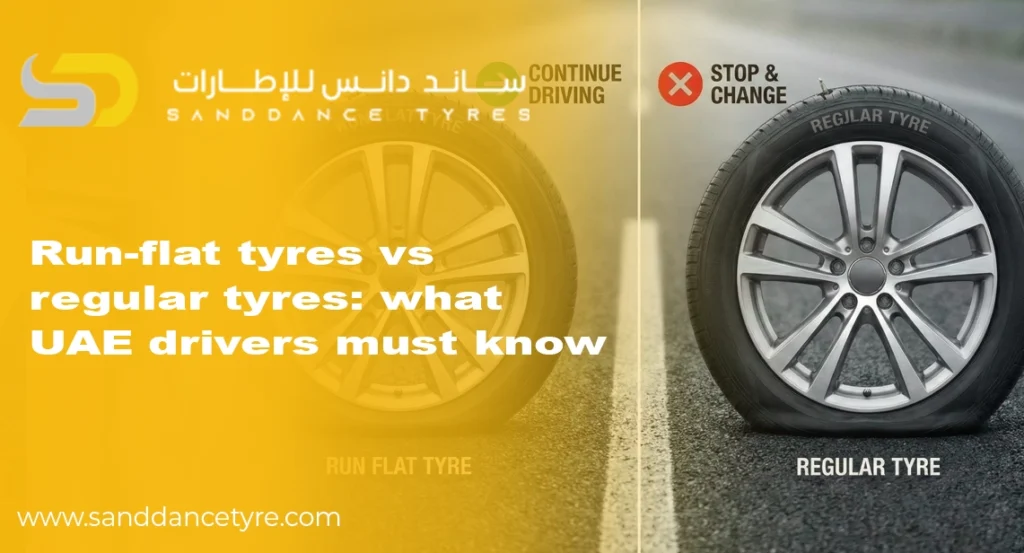
Run-flat tyres are built with reinforced sidewalls that can support the weight of your vehicle even when air pressure drops to zero. Unlike a conventional tyre that goes flat immediately after a puncture, a run-flat tyre lets you keep driving — typically up to 80 km at speeds up to 80 km/h. That’s enough to reach the nearest garage or a safe location without pulling over on a busy highway.
There are two main designs:
- Self-supporting run-flats: The sidewall itself is reinforced with extra rubber to maintain its shape under load.
- Support ring run-flats: A rigid ring inside the tyre supports the car if pressure is lost.
Most passenger vehicles that come factory-fitted with run-flats use the self-supporting design. BMW, Mercedes-Benz, and Mini are among the brands that commonly fit these from the factory.
Run-Flat Tyres vs Regular Tyres: The Core Differences
Understanding run-flat tyres vs regular tyres isn’t just about what happens after a puncture. The differences run deeper than that.
Sidewall Strength and Structure
Regular tyres have flexible sidewalls designed for a smooth, comfortable ride. Run-flat tyres sacrifice a little of that flexibility for structural reinforcement. The result is a slightly firmer ride — something that’s noticeable on rough roads but barely felt on well-maintained UAE highways.
Spare Tyre Requirements
One of the biggest practical differences: run-flat tyres eliminate the need for a spare. Many newer vehicles fitted with run-flats don’t even come with a spare tyre or a jack. This frees up boot space and reduces vehicle weight. For UAE drivers who don’t want to deal with a roadside tyre change in 45°C heat, that’s a genuinely attractive feature.
Regular tyres, on the other hand, require a spare — and if you get a puncture on Emirates Road at midday, you’ll be very grateful you have one.
Cost Comparison
Run-flat tyres generally cost 30–50% more than equivalent regular tyres. They also can’t always be repaired after a puncture — many manufacturers recommend replacing rather than patching a run-flat that has been driven on after a blowout. This adds up over the lifetime of the vehicle.
However, when you factor in the cost of roadside assistance, the inconvenience of a breakdown, and the safety risk of changing a tyre on a UAE highway, the price gap narrows considerably.
Why UAE Driving Conditions Change the Equation
The UAE isn’t a typical driving environment, and that matters when choosing between run-flat tyres vs regular tyres.
Extreme Heat and Tyre Pressure
UAE summer temperatures regularly exceed 45°C on the road surface. Heat is the number one enemy of tyres — it accelerates rubber degradation and makes tyre failures more likely. Regular tyres are more susceptible to pressure fluctuations in extreme heat. Run-flat tyres, with their reinforced sidewalls, handle thermal stress slightly better, though neither type is immune.
Regardless of which type you choose, checking tyre pressure more frequently in summer is essential. Many UAE drivers check weekly during June through September.
Long Highway Stretches Without Services
Driving from Dubai to Abu Dhabi, or heading out toward Al Ain or Fujairah, means long stretches of highway where a breakdown can leave you stranded far from help. A run-flat tyre gives you a buffer — the ability to drive on to a service station rather than waiting on a hard shoulder. For families travelling with children, or anyone driving late at night, that peace of mind is worth paying for.
Sand and Off-Road Risks
If you venture onto desert tracks — even just unpaved roads near construction sites — your risk of a puncture increases significantly. Sharp debris, gravel, and compacted sand can all cause tyre damage. Regular tyres are more repairable in these situations, and their softer sidewalls can be patched more easily. Run-flat tyres that suffer sidewall damage often need full replacement.
For drivers who regularly go off-road or use their vehicles on desert tracks, regular tyres with a good quality spare may actually be the more practical choice.
Vehicles and Compatibility: Not Every Car Can Use Run-Flat Tyres
This is something many UAE drivers don’t realise: run-flat tyres are not universally compatible. Your vehicle needs a Tyre Pressure Monitoring System (TPMS) to use run-flat tyres safely. Without TPMS, you won’t know when a tyre has lost pressure, which defeats the entire purpose of a run-flat.
If your car came factory-fitted with run-flats, switching to regular tyres is possible but requires buying a spare tyre, jack, and wheel brace, and ensuring the vehicle’s suspension is compatible. Some vehicles designed for run-flats have softer suspension calibrated to compensate for the run-flat’s firmer ride — which can behave unexpectedly with standard tyres.
If you’re unsure whether your vehicle is compatible, it’s always worth speaking to a specialist. The team at Sand Dance Tyre can advise on which tyre type suits your specific vehicle and driving patterns in the UAE.
Performance Differences on UAE Roads
Handling and Comfort
On UAE motorways, the difference in ride comfort between run-flat and regular tyres is modest. Where it becomes more noticeable is on older urban roads or speed bumps—run-flats can feel noticeably firmer. If you spend a lot of time on city streets in Dubai or Sharjah, this is worth considering.
Fuel Efficiency
Run-flat tyres are slightly heavier due to their reinforced construction. Over time, this can have a minor impact on fuel consumption. Given the distances UAE drivers cover, that small efficiency difference can add up—though it’s rarely a deciding factor on its own.
Wet and Dry Grip
In dry conditions—which account for most UAE driving—both tyre types perform comparably. In the rare wet conditions during the UAE winter, regular tyres from premium brands can have a slight edge due to their more flexible sidewalls, which adapt better to road surface variations. That said, UAE rainfall is infrequent enough that this difference is rarely a major consideration.
Maintenance Considerations in the UAE Climate
Whatever type you choose, maintenance habits in the UAE need to be adjusted for the climate.
- Tyre pressure: Check monthly as a minimum — weekly in summer. Both run-flat and regular tyres lose pressure faster in extreme heat.
- Visual inspection: Look for cracking or bulging on the sidewalls, which is more common in harsh UV environments.
- Rotation: Rotate every 8,000–10,000 km to ensure even wear across all four tyres.
- Air conditioning effect: Frequent hard braking in heavy Dubai traffic increases wear. Monitor tread depth regularly.
If your vehicle needs a full service check alongside a tyre inspection, car AC repair service is available alongside tyre care — particularly important given how hard vehicle air conditioning works in UAE conditions.
When to Choose Run-Flat Tyres in the UAE
Run-flat tyres make the most sense if:
- Your vehicle came factory-fitted with them and already has TPMS installed
- You frequently drive long inter-emirate routes with limited roadside assistance availability
- You travel with young children or elderly passengers and want to avoid roadside tyre changes
- You drive a premium European vehicle where run-flats are the recommended factory specification
- Boot space is important to you and you’d rather not carry a spare
When Regular Tyres Make More Sense
Standard tyres are likely the better choice if:
- Your vehicle isn’t fitted with TPMS
- You drive off-road or on unpaved surfaces regularly
- Budget is a significant consideration — regular tyres are more affordable to buy and repair
- Ride comfort is a priority, especially on urban roads
- You want more tyre brand options — regular tyres have a wider selection at various price points
For those who want professional fitting wherever they are in the UAE, mobile van service brings expert tyre fitting directly to your location — particularly useful if you’re managing a fleet or simply can’t make it to a garage during working hours.
Choosing the Right Tyre Brand for the UAE
Not all run-flat or regular tyres are created equal. When it comes to UAE conditions, look for brands with strong heat resistance ratings and proven performance in high-temperature markets.
Dunlop is a brand worth mentioning specifically — they produce both run-flat and regular tyres with excellent credentials in hot-climate markets. Their Sport Maxx and SP range have been popular with UAE drivers for consistency and durability. If you’re considering Dunlop, you can explore the Dunlop tyres range available for UAE vehicles.
Other brands commonly recommended for UAE driving include Michelin, Bridgestone, Continental, and Pirelli — all of which offer UAE-appropriate options in both tyre categories.
What Real UAE Drivers Are Saying
Understanding how other drivers in similar conditions experience these tyres is just as important as the technical specs. Here’s what customers have shared:
Customer Reviews
Mohammed Al Rashidi — Dubai Marina ⭐⭐⭐⭐⭐ “I switched to run-flat tyres on my BMW two years ago and haven’t looked back. Got a puncture on Sheikh Zayed Road last summer and drove calmly to the next exit without any stress. For long highway drives, they’re absolutely worth the extra cost. The team helped me pick the right size and explained everything clearly.”
Priya Nair — Sharjah ⭐⭐⭐⭐ “I was worried about the higher price of run-flat tyres, but after getting stranded with a regular tyre blowout near Al Qassimia, I changed my mind completely. Having the confidence to drive to a garage safely is priceless, especially as a solo driver. Very happy with the advice I received — no pressure, just honest guidance.”
James Whitford — Abu Dhabi ⭐⭐⭐⭐⭐ “Honest review: I tried run-flats on my SUV and found the ride too firm for my liking on city roads. Switched back to regular tyres and got a full-size spare fitted instead. The service team respected my decision and didn’t try to oversell me. That kind of honest advice keeps me coming back.”
Fatima Al Mansoori — Ras Al Khaimah ⭐⭐⭐⭐⭐ “We drive long distances every week for family visits between emirates. Run-flat tyres were recommended for our vehicle and the difference in peace of mind on remote stretches of road is real. Also appreciated the mobile service option — they came to us when we couldn’t make it to the garage.”
The Bottom Line: Which Tyre Is Right for You?
There’s no single right answer in the run-flat tyres vs regular tyres debate — it genuinely depends on your vehicle, your routes, and your priorities.
Choose run-flat tyres if your vehicle supports them, you regularly cover long UAE highway distances, and you value safety and convenience over cost savings.
Choose regular tyres if you drive mostly in the city, go off-road occasionally, or want more flexibility in brands and repair options.
What matters most is that your tyres are correctly fitted, properly maintained, and suited to the UAE climate. Getting expert advice before making the switch — rather than guessing — is always the smarter move.
For UAE drivers looking for guidance on run flat tyres, honest advice, and professional fitting, Sand Dance Tyre offers the experience and local knowledge to help you get it right the first time.