
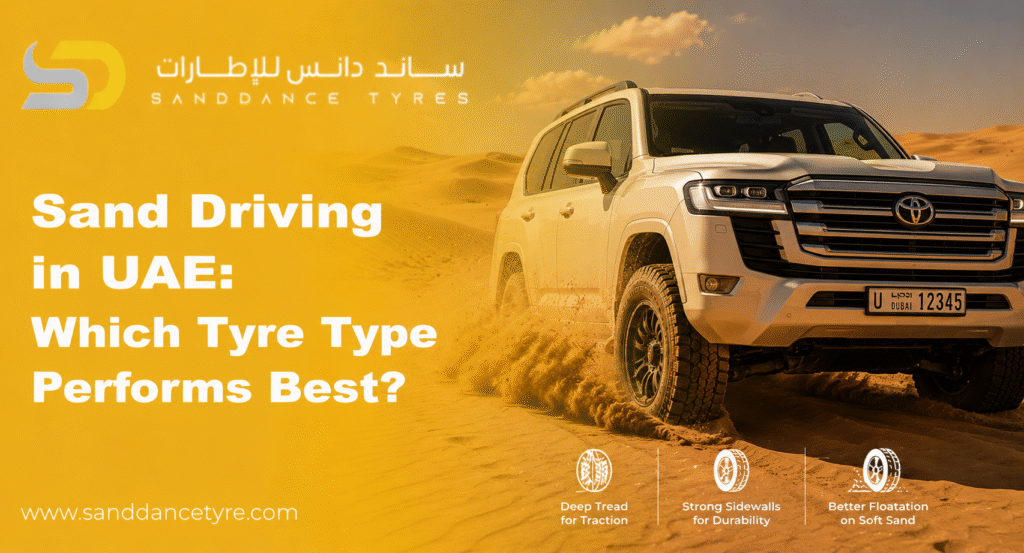
If you’ve ever taken your 4×4 out to the dunes around Al Qudra or pushed through the golden sands near Liwa, you already know that the UAE desert doesn’t forgive bad tyre choices. Sand driving in UAE is a completely different beast compared to highway cruising—and the tyre you’re running can be the difference between a brilliant day out and a long, sweaty recovery session in 45°C heat.
So, which tyre type actually performs best on UAE sand? Let’s break it down properly — no fluff, just real-world insight.
Why Tyre Choice Matters So Much for UAE Sand Driving
Before we get into the specific tyre types, it’s worth understanding why sand is so demanding. Unlike gravel or dirt, loose desert sand shifts under load. Your tyre needs to float above the surface rather than dig through it. That means footprint size, sidewall flexibility, and tread pattern all matter enormously.
The UAE desert also isn’t one uniform surface. You’ve got soft, powdery dunes near the Empty Quarter, harder-packed sand flats in Sharjah, and everything in between. What works brilliantly in one spot can leave you buried in another. This is why experienced off-roaders in the Emirates put serious thought into which rubber they bolt on before heading out.
The Main Tyre Types for Desert Off-Roading
All-Terrain Tyres: The Everyday Workhorse
All-terrain (A/T) tyres are the most popular choice for UAE drivers who split their time between tarmac and sand. They feature a more aggressive tread pattern than standard road tyres, with wider grooves that help shift sand away from the contact patch.
On moderate sand — packed tracks, gentle dunes, A/T tyres perform admirably. They give decent traction without completely sacrificing highway comfort or fuel economy. If you’re doing the occasional desert trip but mostly driving around Dubai or Abu Dhabi, A/T tyres make a lot of sense.
The limitation? When you hit seriously soft, deep sand, all-terrain tyres can start to dig in rather than float. That’s when things get tricky.
Best for: Drivers who split time between city roads and light-to-moderate desert use.
Mud-Terrain Tyres: More Bite, More Compromise
Mud-terrain (M/T) tyres have massive, chunky tread blocks with large voids between them. On mud and rock, they’re exceptional. On sand, though, they’re a mixed bag.
In certain conditions — particularly firmer, coarser sand — that aggressive tread can help find grip. But in the fine, powdery dunes the UAE is famous for, M/T tyres tend to dig aggressively, which is exactly what you don’t want. The large tread voids don’t pack and release sand efficiently at low pressures.
You’ll also feel the road noise compromise significantly on-road, and wear rates on UAE tarmac (which gets brutally hot) can be higher than you’d expect.
Best for: Drivers doing mixed off-road, including rocky wadi terrain — not ideal as a primary UAE dune-driving tyre.
Sand-Specific Tyres and Paddle Tyres: The Purpose-Built Option
Here’s where it gets interesting. Sand-specific tyres — sometimes called “sand tyres” or informally, paddle tyres — are engineered exactly for what UAE desert driving demands. They feature a smooth or lightly ribbed contact area in the center (to reduce dig-in) paired with scoop-shaped outer lugs that propel the vehicle forward.
At reduced pressures (around 15–18 PSI, which experienced UAE off-roaders swear by), these tyres spread across the surface, increasing your footprint dramatically. That flotation effect is the key to moving through deep, soft sand without getting buried.
The obvious trade-off is they’re essentially unusable on tarmac — you’d destroy them, and yourself. They live on spare wheels or are swapped on-site. Serious dune enthusiasts often carry a dedicated set specifically for deep desert excursions.
Best for: Serious desert off-roaders doing deep dune bashing in soft UAE sand.
Tyre Pressure: The Underrated Variable
No conversation about sand driving in UAE is complete without talking about tyre pressure. Even the best tyre for desert use will underperform if you forget to air down. Most UAE off-road guides recommend dropping to 18–22 PSI for moderate sand and as low as 15 PSI for deep, soft dunes.
Airing down increases the tyre’s contact patch, spreads the vehicle’s weight, and prevents the kind of sharp-edged digging that gets you stuck. When you return to the tarmac, airing back up immediately is non-negotiable — driving on public roads at off-road pressures damages the tyre and becomes a safety risk.
A quality tyre deflator tool is a small investment that pays off every single time you head out.
Heat Resistance and UAE-Specific Considerations
One thing that separates UAE desert driving from, say, driving dunes in Australia or the US — the heat. Ground temperatures in UAE sand can exceed 70°C in summer. This puts serious thermal stress on tyres, particularly the sidewalls during low-pressure desert running.
When choosing a tyre for sand driving in the UAE, look for:
- High heat rating (speed ratings H or above for sidewall integrity)
- Reinforced sidewalls to handle low-pressure operation without pinching or deforming
- UV-resistant compounds — UV degradation is a real concern for tyres that sit on vehicles parked outdoors
This is why a cheap tyre that looks fine on paper can fail catastrophically in UAE conditions. Getting proper advice from a tyre specialist who understands the local environment matters. The team at Sand Dance Tyre specifically advises on heat-appropriate tyre selections for the UAE climate and terrain — worth a conversation before your next big desert trip.
What About Sand Driving on Road Tyres?
Short answer: don’t. Stock road tyres weren’t designed for sand traction at any pressure. You’ll be pushing more than floating, and recovery becomes significantly harder. If budget is the constraint, prioritise at least moving to an all-terrain tyre before heading into the dunes.
Real Customer Experiences
⭐⭐⭐⭐⭐ — Ahmed K., Dubai “Switched to all-terrain tyres before a Liwa dune trip after Sand Dance recommended them for my use case — mostly moderate dunes, not deep desert bashing. Night and day difference from my old road tyres. Finally understood what airing down actually does.”
⭐⭐⭐⭐⭐ — Fatima R., Abu Dhabi “Was running mud-terrain tyres thinking they’d be good for sand. Got stuck twice in one trip. The guys at Sand Dance explained exactly why and helped me find a better option. Honest advice, no hard sell.”
⭐⭐⭐⭐⭐ — Marcus D., Sharjah “The team really understands UAE conditions specifically. Not just generic tyre advice — they know the terrain, the heat, and what works here. My new A/Ts handle Sharjah’s sand flats perfectly.”
⭐⭐⭐⭐⭐ — Rania M., Dubai “Quick service, great advice on tyre pressure management for desert trips. Also had my AC looked at while I was there — didn’t expect to get both sorted in one visit. Will definitely return.”
So, Which Tyre Type Actually Wins for UAE Sand?
Here’s the honest answer: it depends on how you drive.
| Driver Type | Best Tyre Choice |
| Mostly city, occasional light dunes | All-Terrain (A/T) |
| Regular weekend desert trips | All-Terrain with reinforced sidewall |
| Mixed wadi + dune off-roading | Mud-Terrain (with awareness of limitations) |
| Hardcore deep dune enthusiast | Sand/Paddle tyre on dedicated wheels |
For the vast majority of UAE drivers — the ones doing weekend family desert trips, moderate dune adventures, or the popular off-road trails around Hatta — a quality all-terrain tyre at the right pressure is the sweet spot. It doesn’t demand that you sacrifice daily commute comfort for weekend fun.
Before You Head Out: A Quick Checklist
- Confirm your tyre type suits your planned terrain
- Check tyre age — desert UV degrades rubber faster than you think
- Carry a tyre deflator and portable compressor
- Know your vehicle’s recommended minimum off-road pressure
- Inspect sidewalls before each desert trip
And if you’re not sure whether your current tyres are actually fit for UAE desert use, it’s worth getting them assessed by someone who knows the local conditions. You can also check whether any other vehicle maintenance — like your air conditioning system — is ready for a long desert day, because nothing ruins a trip faster than a broken AC in July.
Final Thought
Sand driving in the UAE is one of the genuinely unique joys of living here. But it’s a joy that can turn into a frustration, or worse, a safety situation, if you’re rolling on the wrong rubber. Do the homework, get the right tyres for how you actually drive, and the desert becomes a whole lot more enjoyable. For expert tyre advice tailored to UAE conditions, visit Sand Dance Tyre and talk to a specialist who actually understands what these roads — and these sands — demand.