
Best Yokohama Tyres for SUVs in the UAE: Which Model Should You Choose?
Choosing the right tyres for an SUV is important, especially in the UAE, where vehicles regularly experience high temperatures, long highway journeys, heavy traffic, and demanding road conditions. SUV owners need tyres that can provide reliable grip, stability, comfort, durability, and confident handling across different driving environments. Among the many options available today, Yokohama tires are worth considering for drivers looking for a combination of performance and practicality. Yokohama has a dedicated range of GEOLANDAR tyres designed for SUVs, crossovers, and 4×4 vehicles. The official Yokohama Tyres UAE range includes several GEOLANDAR patterns and sizes, covering everything from highway-focused SUVs to vehicles intended for tougher terrain. But which Yokohama tyre is best for your SUV? The answer depends on your vehicle, driving style, tyre size, road usage, and whether you mainly drive on Dubai and Abu Dhabi highways or regularly travel on sand and rough terrain. This guide explains the main options and how to choose the right one for UAE roads. Why Choose Yokohama Tyres for an SUV? SUVs are heavier and generally have a higher centre of gravity than standard passenger cars. This means their tyres have to deal with greater loads while providing enough stability during acceleration, braking, cornering, and highway driving. Yokohama’s GEOLANDAR family is specifically developed around SUV and 4×4 applications. The UAE tyre catalogue lists multiple GEOLANDAR patterns in a broad selection of sizes, load ratings, and speed ratings. This makes Yokohama an interesting option for UAE SUV owners because there is no single tyre that suits every type of SUV driver. A luxury crossover used primarily on Sheikh Zayed Road has different requirements from a Toyota Land Cruiser that regularly travels between highways, desert areas, and off-road locations. The key is to select the model that matches your driving conditions. Best Yokohama Tyres for SUVs in the UAE Some of the most relevant Yokohama SUV tyre families available through the UAE range include the GEOLANDAR X-CV/G058 family, GEOLANDAR G015, GEOLANDAR G056, GEOLANDAR G057, and GEOLANDAR G016. Each has a different purpose. Before purchasing, SUV owners should always confirm the exact size, load index, speed rating, and fitment recommended for their vehicle. 1. Yokohama GEOLANDAR X-CV G058 For SUV owners who spend most of their time on paved roads, the GEOLANDAR X-CV G058 is one of the most interesting options to consider. This tyre is designed for crossover and SUV applications with an emphasis on road performance. Yokohama describes the G058 around wet traction, comfort, mileage, fuel-saving characteristics, and reduced road noise. Its tread design uses a combination of grooves and sipes intended to improve water evacuation, traction, and overall road performance. For UAE drivers, this makes the G058 particularly relevant for daily urban driving and highway travel. An SUV equipped with this type of road-oriented tyre can benefit from a quieter and more refined driving experience. This can be especially useful for drivers who regularly travel long distances between Dubai, Abu Dhabi, Sharjah, and other Emirates. The G058 is also available in SUV sizes through the UAE range. The official UAE catalogue, for example, lists G058 sizes including 215/60R17, 215/65R17, 225/60R17, 235/55R18, 235/60R18, 245/60R18, 235/55R19, and other applications. If your SUV is primarily a city and highway vehicle, the G058 can be an excellent model to investigate. 2. Yokohama GEOLANDAR G015 The GEOLANDAR G015 is a strong option for SUV and 4×4 owners who want a more versatile tyre. Unlike a tyre designed exclusively around urban driving, the G015 is associated with the broader GEOLANDAR SUV and 4×4 family and is available in numerous sizes and configurations in the UAE market. The official UAE catalogue lists G015 fitments across a wide range of wheel sizes and load ratings. This makes the G015 particularly interesting for drivers who divide their time between city roads, highways, and occasional rougher surfaces. For UAE SUV owners, versatility can be valuable. You might drive to work during the week, take a long highway trip at the weekend, and occasionally head toward desert areas. A versatile SUV tyre can provide a better balance than choosing an extremely road-focused or extremely off-road-focused design. The exact performance will depend on the specific size and vehicle application, so drivers should check the recommended fitment rather than choosing a tyre based only on its model name. 3. Yokohama GEOLANDAR G056 The GEOLANDAR G056 is another SUV and 4×4 option that has been offered in the UAE market. Yokohama’s UAE distributor has previously described the G056 as a highway-oriented tyre for 4x4s, SUVs, and crossovers, highlighting durable tread life, all-weather traction, and reduced tread noise. For drivers who spend significant time on highways, these characteristics can be useful. UAE roads are generally well maintained, but highway journeys can involve long periods of continuous driving at relatively high speeds. Tyres therefore need to provide dependable stability and predictable handling. The G056 may be worth considering for SUV owners looking for a balance between highway use and the versatility expected from a 4×4 tyre. Availability should be checked for your specific SUV because not every pattern is offered in every size. 4. Yokohama GEOLANDAR G057 The GEOLANDAR G057 is another model appearing in the UAE’s SUV and 4×4 tyre catalogue. The UAE tyre search currently lists G057 applications including larger SUV fitments such as 275/40R22, 295/40R21, and 295/35R21, among others. This highlights an important point when selecting SUV tyres: wheel size and vehicle configuration matter. Modern SUVs are available with everything from relatively narrow, high-profile tyres to large low-profile tyres mounted on 20-, 21-, or 22-inch wheels. A tyre suitable for one SUV configuration may not be suitable for another. For premium SUVs with larger wheels, checking the manufacturer’s recommended tyre size and load requirements is essential before making a purchase. 5. Yokohama GEOLANDAR G016 For drivers looking for a tyre designed around more demanding 4×4 applications, the GEOLANDAR G016 is another model in the UAE range. The official UAE catalogue lists G016 fitments in sizes such as LT265/70R17, LT295/70R17, LT265/65R17, LT33x12.5R18, LT35x12.5R17, and other
Falken Tyres for the UAE: Which Model Should You Choose?
Driving in Dubai exposes vehicles to high temperatures, busy urban roads, and long highway journeys. Maintaining the correct tyre pressure is important for handling, braking, tyre life, and overall road safety. A Tyre Pressure Monitoring System (TPMS) alerts drivers when tyre pressure falls below a specified level. Understanding how TPMS works, what its warning light means, and why manual pressure checks are still necessary can help UAE drivers maintain their tyres properly and respond quickly to potential pressure loss. Choosing the right Falken Tyres in the UAE is important for safe, comfortable, and reliable performance on UAE roads. The country’s hot climate, high road-surface temperatures, long highway journeys, and occasional heavy rain mean tyres need to provide dependable grip, stability, comfort, and durability. Falken offers a broad range of tyres for different vehicles and driving needs. Why Choose Falken Tyres for UAE Roads? UAE drivers commonly face high temperatures, long highway journeys, busy urban roads, and high-speed motorway driving. A suitable tyre should therefore offer a combination of handling, braking performance, comfort, and resistance to wear. Falken develops tyres for different driving conditions and vehicle categories. Its current car tyre range includes models such as the Ziex ZE320, Azenis FK520, Azenis RS820, e. ZIEX, Sincera SN110, and additional models for different vehicle types and driving needs. For UAE drivers, selecting the right model is more important than simply choosing a tyre from the same brand. A compact sedan used mainly for commuting will have different requirements from a performance car, SUV, or electric vehicle. Falken Ziex ZE320 – A Balanced Choice for Everyday Driving The Falken Ziex ZE320 is one of the most versatile choices for drivers looking for a balance between comfort, handling, and everyday efficiency. Falken describes the Ziex ZE320 as offering balanced performance, wet-road traction, crisp handling, and good rolling resistance. Its design also incorporates technologies intended to reduce road noise and improve ride comfort. This makes it worth considering for drivers who spend most of their time commuting around Dubai, Abu Dhabi, Sharjah, and other UAE cities while also making regular highway journeys. The Ziex ZE320 is particularly suitable if your priorities include: For many everyday drivers, the Ziex ZE320 can be a strong all-round option. Falken Azenis FK520 – For Performance-Focused Drivers If you want sharper handling and stronger performance from your tyres, the Falken Azenis FK520 deserves consideration. The Azenis FK520 is an ultra-high-performance summer tyre developed for drivers who want precise handling and stability. Falken highlights its wet and dry braking performance, high-speed stability, comfort, and reduced noise. It is available across a broad range of sizes, including larger 17- to 22-inch applications, making it suitable for many performance-oriented vehicles. The FK520 may be a better choice if you frequently drive on UAE highways and want more responsive steering and confident handling. It is especially worth considering for: However, performance tyres should always be selected according to the vehicle manufacturer’s recommended tyre size and specifications. Falken Sincera SN110 – Practical and Comfortable For compact and midsize cars, the Falken Sincera SN110 is another option to consider. Falken positions the Sincera SN110 toward cost-conscious compact and midsize vehicle drivers. The tyre uses features designed to support wet and dry grip, straight-line stability, steering response, and comfortable cruising. This type of tyre can make sense for drivers who mainly use their cars for regular city commuting rather than aggressive or high-performance driving. The Sincera SN110 may suit drivers who prioritize: Falken Azenis RS820 – For High-Performance Vehicles Drivers of high-performance and sporty vehicles may want to look at the Falken Azenis RS820. Falken describes the RS820 as a super-ultra-high-performance tyre developed for sporty vehicles. Its design focuses on dynamic dry handling while maintaining safety in wet conditions. The model is offered in larger wheel sizes and is intended for performance-focused applications. For UAE motorists with performance vehicles, this type of tyre can provide a more performance-oriented driving experience than a conventional touring tyre. e. ZIEX – An Option for Electric Vehicles Electric vehicles have different tyre requirements because of their weight, instant torque, and emphasis on efficiency and quiet operation. The Falken e. ZIEX was specifically developed with EV requirements in mind. Falken highlights its wet grip, noise-reduction technologies, and design tailored to electric vehicles. If you drive an electric vehicle in the UAE, it is worth considering a tyre designed specifically around EV requirements rather than choosing solely based on brand or price. Which Falken Tyre Is Best for UAE Driving? There is no single Falken tyre that is perfect for every UAE driver. The best option depends on how and where you drive. For regular city and highway driving, the Ziex ZE320 is a strong all-round candidate because it combines comfort, handling, wet grip, and efficiency. For performance-oriented driving, the Azenis FK520 offers a more dynamic package with strong stability and braking performance. For compact and midsize cars where practical everyday driving is the priority, the Sincera SN110 can be considered. For electric vehicles, the e. ZIEX is specifically designed around EV requirements. For sporty and high-performance vehicles, the Azenis RS820 provides a performance-focused option. What Should You Check Before Buying Falken Tyres? Before purchasing Falken Tyres in the UAE, don’t choose a model based only on price or appearance. Check your vehicle manufacturer’s recommended tyre size, load index, speed rating, and other specifications. You should also consider how you normally drive. A driver who spends most of the week in city traffic may benefit more from a comfortable touring tyre, while someone who regularly drives long distances on highways may prefer additional stability and performance. Tyre age and condition are also important. Even a premium tyre needs proper inflation, alignment, balancing, and regular inspection to perform correctly. Tyre Maintenance in the UAE Climate The UAE’s hot environment makes regular tyre maintenance particularly important. Check tyre pressure according to the vehicle manufacturer’s recommendations and inspect the tyres for uneven wear, cracks, bulges, or other visible damage. Wheel alignment and balancing should also
Can You Drive With a Nail in Your Tyre?
Finding a nail lodged in your tyre is one of those small moments that can cause a big wave of anxiety, especially if you are about to head out on a long drive or you are already running late. The honest answer is that it depends on where the nail is, how deep it has gone, and whether the tyre is already losing air. Understanding the risks involved can help you make a safer decision instead of just hoping for the best. Is It Safe to Drive With a Nail in Your Tyre? In some cases, a tyre with a nail in it can hold air for hours or even days, especially if the nail is small and positioned in the centre of the tread where the rubber is thickest. This does not mean it is truly safe, though. The puncture is still compromising the structure of the tyre, and the seal created by the nail itself is unpredictable. It can shift, fall out, or widen at any moment, leading to a sudden loss of pressure. If the nail has punctured the sidewall rather than the tread, the situation is far more serious. Sidewalls are thinner and flex constantly as the tyre rotates, so a puncture there is much more likely to fail suddenly and without warning, even at low speeds. Signs Your Tyre Has a Nail in It Many drivers only discover a nail during a routine walk-around, but there are warning signs that can alert you sooner. A hissing sound when the vehicle is parked, a dashboard warning light for low tyre pressure, a faint vibration at speed, or the car pulling slightly to one side can all indicate a slow puncture. A visual check of all four tyres, including the inner sidewalls, is the quickest way to confirm what is going on. What Happens If You Keep Driving Continuing to drive on a punctured tyre allows air to escape gradually, and as pressure drops, the tyre flexes more than it is designed to. This generates heat, which weakens the internal structure further and increases the risk of a blowout. Driving on a nearly flat tyre can also damage the wheel rim and, in some cases, affect the suspension or alignment, turning a simple puncture repair into a much costlier repair bill. What to Do If You Find a Nail in Your Tyre If you notice a nail while the car is parked and the tyre still looks properly inflated, the safest approach is to avoid driving on it and arrange for an inspection as soon as possible. Do not attempt to pull the nail out yourself, since it may be the only thing preventing rapid air loss. If you are already on the road and suspect a puncture, reduce your speed, avoid harsh braking or sharp turns, and find a safe place to stop and assess the tyre rather than pushing on to your original destination. Can a Nail in the Tyre Be Repaired? Some punctures in the central tread area may be repairable after a professional inspection. A qualified technician should check the puncture’s location, size, and the tyre’s overall condition before deciding whether repair is appropriate. However, repairs are generally not recommended for punctures in the shoulder or sidewall, for damage larger than a small hole, or for tyres that already have significant wear. A qualified technician can assess the exact location and size of the damage and advise whether a repair is appropriate or whether replacement is the safer option. Conclusion A nail in your tyre should never be treated as a minor inconvenience to deal with later. Even if the tyre seems to be holding air, the safest course of action is to have it inspected promptly, avoid unnecessary driving on it, and let a professional determine whether it can be repaired or needs replacing. Taking a cautious approach now can prevent a much more dangerous situation on the road.
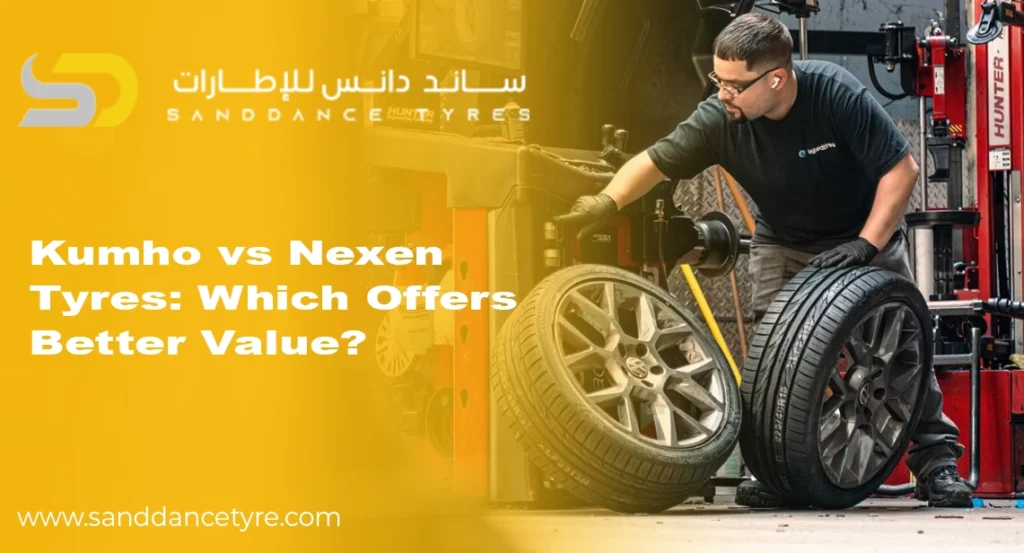
Kumho vs Nexen Tyres: Which Offers Better Value?
Choosing between two well-known tyre brands can be difficult when both offer competitive prices and a wide range of options. Kumho vs Nexen Tyres is a common comparison for drivers who want dependable performance without paying premium-brand prices. Both Kumho and Nexen are South Korean tyre manufacturers with passenger car, SUV, touring, performance, and other tyre options. Their products are positioned across several categories, so the better choice depends less on the brand name and more on the specific tyre model, size, driving conditions, and what you value most. For drivers in the UAE, factors such as high temperatures, motorway speeds, long-distance driving, road noise, braking performance, and tyre durability can all influence the buying decision. So, between Kumho and Nexen tyres, which offers better value? The answer is not simply one brand for every driver. Kumho can be particularly attractive for drivers who prioritise balanced handling and wet-road performance, while Nexen can be a strong option for drivers looking for comfort, quiet running, and everyday value. Kumho vs Nexen Tyres at a Glance Feature Kumho Tyres Nexen Tyres Brand origin South Korea South Korea Main positioning Mid-range/value Mid-range/value Dry-road performance Strong on suitable performance models Strong on suitable performance models Wet-road performance Strong on several tested models Competitive across various models Comfort Good Very good on comfort-focused models Road noise Good Often a strength Highway driving Good Good SUV options Wide range Wide range Performance tyres Ecsta range N’Fera range Touring/comfort options Solus range N’Priz range Best suited to Balanced performance and value Comfort and everyday value This comparison is a general guide. Tyre performance can change considerably between individual models and sizes. What Makes Kumho and Nexen Popular? Kumho and Nexen occupy a useful position for drivers who want to move beyond basic budget tyres without automatically paying premium-brand prices. Kumho offers passenger tyres across categories including comfort, touring, eco, high-mileage, performance, and sports applications. Its passenger range is designed around different driving requirements rather than offering one tyre for every type of vehicle. Kumho also invests heavily in tyre technology and testing. Its technology portfolio includes developments aimed at maintaining tyre shape, improving braking performance, and supporting steering stability. Nexen follows a similar approach, with different tyre families designed around passenger cars, SUVs, performance vehicles, and other applications. That means comparing the two brands only by name can be misleading. A Nexen touring tyre and a Kumho performance tyre may have completely different characteristics even if they fit the same vehicle. Kumho vs Nexen Tyres: Performance Comparison 1. Dry-Road Grip Dry-road grip is important for everyday driving, especially when travelling on highways or changing lanes at higher speeds. Kumho has several tyres designed with handling and steering response in mind. Its performance-focused Ecsta range, for example, is aimed at drivers who want stronger handling characteristics. Nexen also produces performance-oriented tyres, particularly within its N’Fera range. These tyres can provide responsive handling while maintaining the comfort expected from a road-going tyre. The difference becomes more noticeable when comparing specific models rather than entire brands. Winner: Kumho for performance-focused driving, but model choice matters. For normal city driving, however, most drivers are unlikely to notice a dramatic difference between comparable Kumho and Nexen models when both are correctly sized and properly maintained. 2. Wet-Road Performance Wet grip deserves particular attention because a tyre can feel excellent on dry roads but behave differently when water is present. Independent comparisons between specific Kumho and Nexen performance tyres have shown that Kumho can have an advantage in wet braking and aquaplaning resistance. For example, testing of the Kumho Ecsta PS71 against the Nexen N Fera Sport SU2 found stronger wet braking and aquaplaning performance for the Kumho, while the Nexen showed strengths in noise, efficiency, and some value-related measures. However, this should not be interpreted as meaning every Kumho tyre is better than every Nexen tyre in the rain. Tread design, compound, tyre age, pressure, size, vehicle weight, and road conditions all influence wet performance. Winner: Kumho on several comparable performance models. 3. Ride Comfort If your priority is a smooth and relaxed drive, comfort becomes more important than aggressive handling. Nexen has built a strong reputation around comfortable everyday driving, particularly with its touring-oriented products. Independent 2026 testing of Korean all-season tyres found the Nexen N Priz S particularly strong for comfort and cabin noise. Kumho also offers comfort-focused tyres. Its Solus range includes products designed for everyday passenger-car use, while other Kumho models place more emphasis on handling and performance. For UAE drivers who spend hours commuting through Dubai, Abu Dhabi, Sharjah, or other Emirates, a comfortable tyre can make a noticeable difference. Winner: Nexen for comfort-focused driving. 4. Road Noise Tyre noise becomes more noticeable on smooth highways, particularly when driving at higher speeds. Nexen performed strongly for noise and comfort in the 2026 AutoView Korean all-season test. The Nexen N Priz S recorded the lowest noise figure among the tyres tested, while the N Fera Supreme also scored well for subjective noise. That makes Nexen an appealing choice for drivers who spend considerable time on motorways and prefer a quieter cabin. Kumho is not necessarily noisy. Several Kumho models are designed with ride refinement in mind. The difference depends heavily on the individual tread pattern and vehicle. Winner: Nexen for drivers who prioritise low road noise. 5. Highway Driving Highway driving places different demands on tyres compared with short city trips. A good highway tyre should provide: Both brands offer tyres suitable for highway use, but the right model should be selected according to your vehicle and driving pattern. Kumho can be attractive if you prefer a more responsive steering feel. Nexen can make sense if comfort and quieter cruising are higher priorities. For long UAE road trips, don’t choose solely by brand. Check the exact tyre specification, load index, speed rating, manufacturing date, and recommended vehicle size. Winner: Tie, depending on the specific tyre model. 6. SUV and Crossover Driving SUV drivers have different requirements because
What to Do When Your Car Gets a Flat Tyre in Dubai
Getting a flat tyre in Dubai can happen when you least expect it. You may be driving to work on Sheikh Zayed Road, heading home through Al Khail Road, or travelling across the city when you suddenly notice that your steering feels different, the vehicle starts pulling to one side, or the tyre-pressure warning light appears on the dashboard. A flat tyre can be stressful, especially in heavy traffic or during Dubai’s hot weather, but knowing what to do can help you stay safe and avoid further damage. The most important thing is not to panic and not to continue driving on a severely deflated tyre. A damaged tyre can affect steering, braking and vehicle stability. Dubai’s Roads and Transport Authority (RTA) regularly advises motorists to check tyre pressure and condition and has specifically highlighted the importance of tyre maintenance during periods of high temperature. If you experience a flat tyre, move your vehicle to a safe location if possible, switch on your hazard lights and assess the situation before deciding whether you can safely change the tyre yourself or need roadside assistance. What Causes a Flat Tyre in Dubai? A flat tyre can have several causes. Understanding them can help you prevent the same problem from happening again. One of the most common causes is a puncture. A nail, screw, piece of metal or other sharp object can enter the tread and gradually release air. Sometimes the driver notices the problem immediately, while in other cases the tyre loses pressure slowly over several hours or days. Low tyre pressure can also contribute to tyre problems. When a tyre is consistently underinflated, more of its surface comes into contact with the road. This can increase heat buildup and place additional stress on the tyre structure. Dubai’s climate is another reason why regular tyre checks matter. High temperatures can increase pressure changes and place additional demands on tyres. RTA’s summer safety guidance encourages motorists to make tyre inspections part of their routine and ensure tyres are correctly inflated, structurally sound and free from cracks. A damaged valve, wheel problem, ageing tyre, sidewall damage or worn tread can also cause air loss. In some cases, a tyre may look acceptable from a distance but have internal or sidewall damage that makes it unsafe. How Do You Know You Have a Flat Tyre? Not every flat tyre happens suddenly. Some drivers notice several warning signs before the tyre becomes completely flat. Your car may begin pulling toward one side, particularly when you try to maintain a straight line. The steering wheel may also feel heavier or different from normal. You might hear repetitive thumping, flapping or unusual road noise. Modern vehicles may display a tyre-pressure monitoring warning on the dashboard. If the warning appears, do not simply reset it and continue driving without checking the tyre. Another obvious sign is a tyre that looks visibly lower than the others. However, visual inspection alone is not always enough. Some tyres can lose a significant amount of pressure without appearing completely flat. If your vehicle suddenly behaves differently, reduce your speed gradually and look for a safe place to stop. What Should You Do Immediately After Getting a Flat Tyre? The first priority is your safety, not the tyre. If you feel the tyre losing pressure while driving, keep a firm grip on the steering wheel and avoid sudden braking or sharp steering movements. Gradually reduce your speed and look for a safe location away from moving traffic. If you can safely reach a suitable shoulder, parking area or other protected location, stop there. Switch on your hazard warning lights so other drivers can see that your vehicle has a problem. Do not stop in the middle of a traffic lane simply because the tyre has gone flat. RTA has emphasized the danger of stopping in the middle of the road and advises drivers facing emergencies to seek appropriate assistance. Once the vehicle is stationary, apply the parking brake and assess the situation. If you are on a busy road and changing the tyre would place you close to moving traffic, do not attempt the repair simply because you have a spare wheel in the boot. Roadside tyre replacement should only be performed when the location is genuinely safe. Should You Keep Driving With a Flat Tyre? In most situations, no. Driving on a completely flat or severely underinflated tyre can damage the tyre’s sidewall and internal structure. It can also affect steering control and braking performance. Even if your destination is only a few kilometres away, continuing to drive may turn a repairable puncture into a tyre replacement. The wheel itself can also potentially be damaged. Run-flat tyres are an exception because some vehicles are specifically designed to travel a limited distance after losing pressure. However, the manufacturer’s instructions and the vehicle’s tyre specifications should always be followed. A normal tyre should not be treated like a run-flat tyre. If you are uncertain whether your tyre can safely support further driving, stop and arrange professional assistance. Find a Safe Place Before Changing the Tyre If you have enough control to move the vehicle, look for a safe location rather than immediately stopping wherever the puncture occurs. A suitable location should be away from fast-moving traffic and provide enough space around the vehicle to work safely. Avoid attempting a tyre change on a narrow road shoulder when vehicles are passing close to you. Also avoid standing behind or directly beside your vehicle in an exposed traffic area. Turn on your hazard lights and keep passengers away from traffic. Children should remain inside the vehicle when it is safer for them to do so, rather than standing beside the road. If the location is unsafe, calling roadside assistance is usually the better option. Can You Change a Flat Tyre Yourself? Yes, if you have the correct equipment, understand the process and are in a safe location. Most vehicles that use a conventional spare wheel will
Best Goodyear Tyres for Highway Driving in Dubai
Driving on Dubai’s highways demands tyres that can handle long distances, high temperatures, fast-moving traffic and changing road conditions. Whether you regularly travel along Sheikh Zayed Road, commute between Dubai and Abu Dhabi, or take longer road trips across the UAE, your tyres play an important role in braking, handling, ride comfort and overall driving confidence. Choosing the right Goodyear Tyres can help you get a better balance of grip, stability, comfort and durability for everyday highway driving. Goodyear offers several tyre families designed for different driving requirements. Its range includes Eagle tyres for performance-oriented driving, Assurance tyres for everyday use and Wrangler options for SUVs and drivers who need more versatility. However, the best tyre is not necessarily the most expensive or sportiest model. Your vehicle, tyre size, driving habits and typical road conditions should all be considered before making a decision. For Dubai drivers, highway tyre selection is particularly important because the vehicle can spend considerable time travelling at motorway speeds. A good highway tyre should provide predictable steering, strong road contact, stable cornering, controlled braking and a comfortable ride without compromising durability. Why Choose Goodyear Tyres for Highway Driving? Goodyear has a broad range of tyres covering everyday driving, performance, SUVs and other applications. The company currently lists models across categories including commuter, sport performance, all-season and all-terrain tyres. This variety makes the brand suitable for different types of Dubai motorists. For highway driving, one of the biggest advantages is the ability to select a tyre based on how you actually use your vehicle. A driver with a family sedan may prioritise comfort and mileage, while someone with a performance car may want sharper steering response and stronger cornering behaviour. An SUV owner may need a different balance of highway stability and additional versatility. The right Goodyear Tyres can also make a noticeable difference to the feel of a vehicle. Tyres influence how the steering responds, how the car behaves during lane changes and how much road noise enters the cabin. This becomes especially noticeable during long journeys when small differences in comfort and stability can add up. What Makes a Good Highway Tyre for Dubai? Dubai’s highway environment is different from many other driving conditions. Drivers regularly encounter long stretches of motorway, high daytime temperatures, heavy traffic and sudden changes in speed. These factors make tyre selection more important than simply choosing a tyre based on price. A good highway tyre should offer a stable contact patch with the road. This helps the vehicle feel planted when travelling at higher speeds and can provide more predictable steering during lane changes. Wet-road performance is also worth considering. Although Dubai is known for its dry climate, rain can create challenging conditions because roads that are normally dry may become slippery when rainfall occurs. Goodyear’s performance and everyday-driving ranges include tyres designed with wet-road traction and handling characteristics in mind. For example, the Eagle F1 Asymmetric All-Season is designed around wet and dry handling, while Goodyear’s Assurance family focuses on dependable everyday traction and control. Comfort is another important factor. If you drive between Dubai and Abu Dhabi several times a week, a tyre that reduces road harshness and cabin noise can make long journeys more pleasant. Best Goodyear Tyres for Highway Driving There is no single Goodyear model that is ideal for every car. However, several tyre families are worth considering depending on your vehicle and priorities. 1. Goodyear Eagle F1 Range for Performance-Oriented Highway Driving Drivers who enjoy responsive steering and stronger road handling may want to look at the Goodyear Eagle F1 family. Goodyear positions the Eagle range around premium sport-driving performance, with several models designed for performance applications. The Eagle F1 range can be particularly appealing for drivers who spend a lot of time on highways but also want a more engaging driving experience. These tyres are designed with handling and responsiveness in mind rather than simply focusing on basic transportation. For example, the Eagle F1 Asymmetric All-Season uses an asymmetric tread design and is described by Goodyear as offering precise handling on wet and dry roads, along with wet traction and cornering stability. For Dubai drivers with compatible performance-oriented cars, an Eagle F1 model can therefore be worth considering when steering response and handling are higher priorities. However, buyers should always check the exact specification available for their vehicle. Some Eagle F1 variants are summer tyres, while others are all-season products, and specifications vary according to size and market. Goodyear’s current range includes several Eagle F1 versions rather than one universal model. 2. Goodyear Assurance for Comfortable Daily Highway Driving For drivers who use their vehicle primarily for commuting, family travel and regular highway journeys, the Assurance family may be more appropriate. Goodyear describes its Assurance tyres as being designed for everyday driving, with emphasis on traction, dependable control and comfort. The manufacturer specifically positions the family for commuting, carpooling and road trips. This makes the Assurance range relevant to many Dubai motorists who do not need an aggressive performance tyre. If your typical routine involves travelling from residential areas to business districts, making regular inter-emirate journeys or taking your family on weekend road trips, a comfort-focused tyre can make more sense than choosing a maximum-performance model. The exact Assurance model should still be selected according to your vehicle’s original tyre specification. Goodyear’s current range includes options such as Assurance MaxLife 2, Assurance ComfortDrive and Assurance WeatherReady 2 in its broader catalogue, although availability and specifications can vary by market and tyre size. 3. Goodyear Assurance MaxLife for Drivers Focused on Mileage Drivers who cover a lot of kilometres may be particularly interested in long-wearing tyre options. Goodyear currently includes Assurance MaxLife among its everyday-driving tyres and lists an 85,000-mile warranty for the model in its US catalogue. Warranty terms, product availability and specifications can differ by country, so UAE buyers should confirm the locally supplied version before purchasing. For a Dubai driver who spends hours on highways every week, tyre longevity can
What Size Tyres Does My Car Need? A Simple Guide
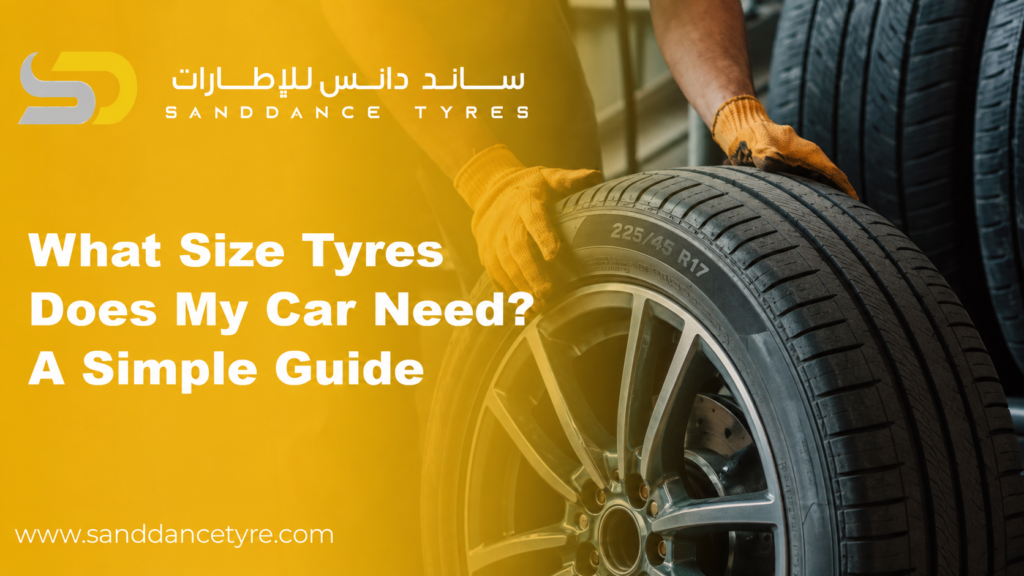
Choosing the right tyres for your car can seem confusing, especially when you see numbers such as 205/55 R16 91V written on the sidewall. If you are wondering, tyre size, the answer is usually easier to find than you might think. Your vehicle manufacturer provides a recommended tyre size based on the car’s weight, wheel dimensions, handling characteristics, and performance requirements. You can normally find this information on the driver’s door-jamb sticker, in the owner’s manual, or on the current tyre sidewall. However, the current tyre should only be used as a reference if it matches the manufacturer’s recommended specification. Understanding tyre sizes in UAE before buying a replacement can help you avoid poor fitment, reduced comfort, handling problems, and unnecessary expenses. What Does a Tyre Size Mean? A tyre size is made up of numbers and letters that describe important characteristics of the tyre. For example, consider: 205/55 R16 91V Each part tells you something different about the tyre. 205 represents the tyre’s nominal width in millimetres. In this example, the tyre is approximately 205 mm wide. 55 is the aspect ratio. It means the tyre’s sidewall height is 55% of its width. R means the tyre uses radial construction, which is standard for most modern passenger vehicles. 16 represents the wheel or rim diameter in inches, so this tyre is designed for a 16-inch wheel. 91 is the load index, which indicates the tyre’s maximum load capacity under specified conditions. V is the speed rating, indicating the tyre’s rated speed capability under specified testing conditions. Understanding this code makes it much easier to compare tyres and check whether a particular option is suitable for your vehicle. Where Can I Find My Car’s Tyre Size? If you don’t know your tyre size, don’t guess. There are several places where you can check it. Check the Driver’s Door Sticker The driver’s door frame or door jamb is one of the best places to find the manufacturer’s recommended tyre size. Many vehicles also display the recommended cold tyre pressures on the same sticker. This information is particularly useful if your current tyres have been replaced with a different size by a previous owner. Check the Owner’s Manual Your vehicle owner’s manual normally includes tyre specifications and recommended inflation pressures. Depending on the vehicle, there may be different specifications for different wheel or tyre options. Look at the Current Tyre You can also look at the sidewall of your existing tyre. You should see a code similar to 195/65 R15 or 225/45 R17. However, don’t automatically assume that the existing tyre is the correct size. If the vehicle has previously been modified or fitted with the wrong tyres, the sidewall information may not represent the manufacturer’s original recommendation. Why Is the Correct Tyre Size Important? Tyre size affects more than whether the tyre physically fits your wheel. The correct specification helps maintain the handling, ride comfort, braking characteristics, and overall behaviour the vehicle was designed to provide. Installing an unsuitable tyre size can potentially affect steering response, ground clearance, suspension clearance, fuel consumption, speedometer readings, and ride quality. For example, moving to a much wider tyre may change steering feel and rolling resistance. Choosing a much lower-profile tyre can also make the ride feel firmer because there is less sidewall to absorb road impacts. This is why choosing the biggest tyre that fits the wheel is not necessarily the best approach. Can I Put a Different Size Tyre on My Car? Sometimes a vehicle can safely use more than one tyre size. Manufacturers may offer different wheel and tyre combinations depending on the model, trim level, or optional equipment. However, you should not change tyre size simply because another size looks better or is cheaper. If you want to upsize or downsize your tyres, check the vehicle manufacturer’s approved specifications and make sure the replacement tyre has suitable load and speed ratings. A professional tyre specialist can also check wheel width, clearance, overall diameter, and compatibility. The goal is to maintain a suitable overall combination rather than changing only one measurement. What Are Load Index and Speed Rating? Many drivers focus on the first part of the tyre code and overlook the numbers and letters that follow it. For example, in 205/55 R16 91V, 91 is the load index and V is the speed rating. The load index tells you the tyre’s rated load-carrying capacity. The speed rating represents the tyre’s rated speed capability under specified conditions. These ratings matter because two tyres can have the same physical size but different load and speed ratings. Therefore, matching only the width, aspect ratio, and rim diameter isn’t always enough. When replacing tyres, use ratings that meet the vehicle manufacturer’s requirements rather than selecting a tyre based only on price. Should All Four Tyres Be the Same Size? For many standard passenger vehicles, the four tyres are the same size. However, some cars, particularly performance vehicles, may use different front and rear tyre sizes. Never assume that all four wheels should have identical dimensions. Check your vehicle’s specifications before ordering tyres. If the vehicle uses different front and rear sizes, fitting the wrong combination can affect handling and vehicle systems. When replacing tyres, it is also important to consider the vehicle’s drivetrain and manufacturer recommendations. What Happens If You Choose the Wrong Tyre Size? Installing the wrong tyre size can create several problems. A tyre that is too wide may have clearance issues and could potentially contact suspension or body components. A tyre that is too tall can alter the vehicle’s ride height and speedometer readings. A tyre with a significantly different overall diameter can also affect vehicle behaviour and, on some modern cars, systems that rely on wheel-speed information. An unsuitable tyre can also change the balance between comfort, handling, road noise, and fuel efficiency. For these reasons, tyre selection should start with the manufacturer’s recommended specification rather than appearance. What Tyre Size Is Best for My Car? The best tyre size
UAE Fuel Prices Update September 2026: Petrol and Diesel Rates
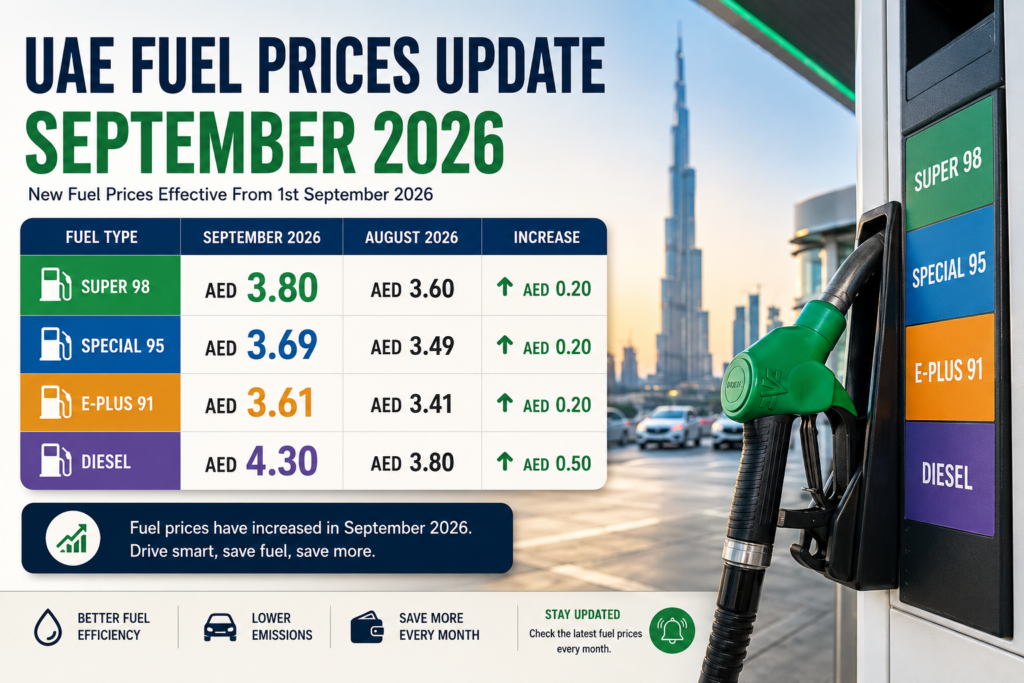
The UAE fuel prices for September 2026 have increased across all petrol categories and diesel compared with August. The new rates came into effect on September 1, 2026, following the monthly review by the UAE Fuel Price Committee. For September, motorists in Dubai, Abu Dhabi, Sharjah and other UAE emirates will pay AED 3.80 per litre for Super 98, AED 3.69 for Special 95, AED 3.61 for E-Plus 91 and AED 4.30 for diesel. The biggest increase was recorded for diesel, which rose by AED 0.50 per litre from August. Petrol prices increased by AED 0.20 per litre across all three grades. UAE Fuel Prices for September 2026 Here is the latest UAE petrol price update for September 2026: Fuel Type September 2026 August 2026 Increase Super 98 AED 3.80/L AED 3.60/L AED 0.20 Special 95 AED 3.69/L AED 3.49/L AED 0.20 E-Plus 91 AED 3.61/L AED 3.41/L AED 0.20 Diesel AED 4.30/L AED 3.80/L AED 0.50 The petrol increases range from approximately 5.56% to 5.87%, while diesel increased by around 13.16% compared with August. Why Have UAE Fuel Prices Increased in September 2026? The UAE adjusts retail fuel prices monthly according to movements in global energy markets. The country’s fuel-pricing mechanism takes international oil-price trends into consideration along with distribution and operating costs. Global oil markets have remained volatile during 2026 because of regional geopolitical developments and uncertainty surrounding oil supplies. These changes can influence the average cost used to determine fuel prices in the UAE. As a result, UAE motorists are seeing higher prices in September compared with July and August. How Much More Will a Full Tank Cost? The effect of the September increase depends on your vehicle’s fuel-tank capacity. For example, a 60-litre tank would cost: For comparison, filling a 60-litre tank with Special 95 in August cost AED 209.40. This means the same tank now costs AED 12 more. For Super 98, the increase is also AED 12 for a 60-litre tank, while a 60-litre diesel fill-up is AED 30 more than in August. September Fuel Costs for Different Vehicle Sizes The actual amount you spend depends on your vehicle’s fuel-tank size. As an example, a compact car with a 51-litre tank would require approximately AED 193.80 for a full tank of Super 98, while a 74-litre SUV would cost approximately AED 281.20. Compact Car For a 51-litre tank: Sedan For a 62-litre tank: SUV For a 74-litre tank: These figures show why even a relatively small increase in the price per litre can have a noticeable effect on motorists who frequently fill larger vehicles. Is September 2026 Fuel More Expensive Than Earlier This Year? Not necessarily. Although prices increased in September compared with August, September rates remain below some of the higher prices recorded earlier in 2026. For example, Super 98 reached AED 3.95 per litre in June, compared with AED 3.80 in September. Special 95 reached AED 3.83 in June, compared with AED 3.69 now. Diesel also remains below its 2026 peak. It reached AED 4.69 per litre in April and May, compared with AED 4.30 in September. Therefore, although September brings another increase, motorists are still paying less than the year’s highest rates for each fuel category. How UAE Fuel Prices Affect Monthly Driving Costs For people who commute long distances every day, fuel-price changes can have a noticeable impact on monthly expenses. For example, a driver using 240 litres of Special 95 per month would spend: 240 × AED 3.69 = AED 885.60 At June’s Special 95 rate of AED 3.83, the same 240 litres would have cost AED 919.20. That represents a difference of AED 33.60. For businesses operating several vehicles, taxis, delivery vehicles or diesel-powered fleets, the impact can be considerably larger because monthly fuel consumption is much higher. Petrol vs Diesel: Which Saw the Bigger Increase? Diesel experienced the biggest increase in September. Petrol prices rose by AED 0.20 per litre across all three grades: Diesel increased from AED 3.80 to AED 4.30 per litre, representing a rise of AED 0.50 per litre. This makes diesel particularly important for commercial drivers and businesses that operate vans, trucks and other diesel-powered vehicles. How Can UAE Drivers Reduce Fuel Costs? Although motorists cannot control the official pump price, they can reduce their overall fuel expenses by improving fuel efficiency. Maintain Correct Tyre Pressure Under-inflated tyres can increase rolling resistance and make the engine work harder. Checking tyre pressure regularly can help maintain fuel efficiency. Keep Your Vehicle Maintained Regular servicing, clean air filters, properly functioning spark plugs and timely oil changes can help your vehicle operate efficiently. Avoid Aggressive Driving Rapid acceleration, hard braking and unnecessary high-speed driving can increase fuel consumption. Smooth acceleration and maintaining a consistent speed can help reduce fuel usage. Reduce Unnecessary Weight Carrying heavy items that you do not need can increase fuel consumption. Removing unnecessary luggage and equipment can make the vehicle more efficient. Plan Your Routes Frequent traffic congestion, unnecessary detours and repeated short trips can increase fuel consumption. Planning routes before travelling can help reduce both driving time and fuel use. What Are the Current UAE Fuel Prices in September 2026? The official September 2026 rates are: Super 98: AED 3.80 per litreSpecial 95: AED 3.69 per litreE-Plus 91: AED 3.61 per litreDiesel: AED 4.30 per litre These rates became effective on September 1, 2026 and apply across the UAE. What to Expect From Future UAE Fuel Price Updates UAE fuel prices are reviewed monthly, so the next adjustment will depend on developments in international oil markets and the pricing mechanism used by the UAE Fuel Price Committee. Motorists should therefore check the monthly announcement before budgeting for longer journeys, business transportation or fleet operations. Frequently Asked Questions What is the petrol price in UAE in September 2026? In September 2026, Super 98 costs AED 3.80 per litre, Special 95 costs AED 3.69, and E-Plus 91 costs AED 3.61 per litre. What is the diesel price in UAE in September 2026?
Hankook Tyres Review: Are They Worth Buying in the UAE?
Choosing the right tyres is one of the most important decisions for any driver in the UAE. The country’s hot climate, high road temperatures, long highways, heavy traffic, and occasional rain can put significant demands on your tyres. This is why many drivers look beyond price and consider factors such as grip, braking, comfort, durability, road noise, and performance. Hankook Tyres are an option worth considering if you are looking for a balance between performance, comfort, technology, and value. Hankook offers tyres for passenger cars, SUVs, electric vehicles, vans, and commercial vehicles. But are Hankook tyres actually worth buying in the UAE? The short answer is yes, for many drivers. However, the right Hankook tyre depends on your vehicle, driving style, tyre size, and the conditions in which you normally drive. A performance tyre designed for a sporty sedan may not be the best choice for an SUV used for long-distance highway driving. In this review, we’ll examine Hankook tyres in detail and explain why they may be a suitable choice for UAE drivers. What Are Hankook Tyres? Hankook is a global tyre manufacturer headquartered in South Korea. The company produces tyres for different vehicle categories and driving requirements, ranging from passenger cars and SUVs to electric vehicles and commercial applications. Its current portfolio includes several specialised tyre families. Ventus focuses on performance, Dynapro is designed for SUVs and pickup trucks, Kinergy focuses on balanced comfort and everyday driving, while iON is developed specifically for electric vehicles. This wide range is important because there is no single tyre that is perfect for every driver. For example, someone driving a BMW or Audi and looking for sharper handling may prefer a performance-oriented Ventus model. On the other hand, a family sedan owner who spends most of the week driving around Dubai may prefer a comfortable touring tyre. Hankook’s Middle East and Africa range currently includes products such as Ventus Prime4, Ventus evo SUV, Dynapro HP3, Dynapro HPX, Dynapro AT2 Xtreme, Kinergy eco2, and Kinergy 4S2, depending on vehicle and application. Are Hankook Tyres Good for UAE Roads? Yes, Hankook Tyres can be a good option for UAE roads when you select the correct model and specification. Driving conditions in the UAE are different from many other markets. Temperatures can become extremely high during summer, while highways encourage sustained speeds and long journeys. Urban driving adds another challenge, with frequent braking, acceleration, lane changes, and stop-and-go traffic. A good tyre therefore needs to offer more than just long tread life. It should provide dependable dry-road grip, predictable braking, acceptable road noise, good steering response, and enough durability for everyday use. Hankook offers different tyre designs for these requirements. Its Middle East range includes tyres categorised according to characteristics such as dry performance, wet performance, comfort, durability, mileage, noise, and handling. However, it is important to remember that Hankook is a brand, not a single tyre model. Comparing the brand alone is not enough. You should always compare the specific Hankook model with alternatives in the same category. Hankook Tyres Performance Performance is one of the strongest reasons to consider Hankook. The Ventus range is particularly focused on drivers who want responsive handling and strong road performance. Hankook describes Ventus as its premium performance tyre family, with an emphasis on grip, braking power, durability, and ride quality. This makes certain Ventus tyres suitable for drivers who enjoy responsive steering and confident highway driving. For everyday UAE driving, however, you do not necessarily need the most performance-oriented tyre available. A touring or comfort-focused model may provide a better overall experience. The key is matching the tyre to your driving requirements. If you regularly travel between Dubai, Abu Dhabi, Sharjah, or other emirates, highway stability and predictable handling may matter more than aggressive cornering performance. If you mostly drive within the city, comfort, noise levels, braking, and mileage may be higher priorities. How Do Hankook Tyres Perform in Hot Weather? Hot weather is an important consideration when buying tyres in the UAE. Tyres naturally generate heat while driving, and high ambient temperatures, hot asphalt, vehicle weight, speed, and incorrect tyre pressure can place additional stress on them. Hankook uses different tread designs and tyre constructions for different vehicles and driving conditions. Therefore, the best approach is to choose a model that matches your vehicle and driving requirements. Drivers should also remember that tyre maintenance is just as important as tyre brand. Even a premium tyre can perform poorly if it is significantly underinflated, overloaded, incorrectly aligned, or badly worn. Checking tyre pressure regularly is particularly important in the UAE. You should follow the vehicle manufacturer’s recommended cold tyre pressure rather than simply using the maximum pressure printed on the tyre sidewall. Hankook Tyres and Wet-Road Grip Although the UAE is generally dry, rain can create challenging road conditions. When rain arrives after a long dry period, oil, dust, and other contaminants on the road surface can reduce available grip. This makes wet braking and water evacuation important considerations. Hankook offers products designed with wet-road performance in mind. For example, its Kinergy range includes tyres developed around balanced performance, while the Kinergy 4S2X uses wide lateral grooves and other tread features designed to improve water drainage. The important point is not to assume that every Hankook tyre has identical wet performance. Always check the specifications of the exact model you are considering. Comfort and Road Noise Comfort is another area where the right Hankook model can make a noticeable difference. Tyres influence how much road vibration reaches the cabin. Tread design, tyre construction, sidewall characteristics, vehicle suspension, road surface, and tyre pressure can all affect the driving experience. Kinergy is Hankook’s comfort-focused product family, designed around balanced driving performance and ride quality. For drivers who spend considerable time commuting through Dubai traffic or travelling long distances, a comfortable tyre can make everyday driving more pleasant. However, there is usually a trade-off between comfort and sporty handling. A high-performance tyre with a stiffer construction may feel
Tyre Rotation vs Wheel Alignment: What’s the Difference?
If you have ever been told that your car needs a tire rotation vs. wheel alignment service, you may wonder whether both mean the same thing. They do not. Although tyre rotation and wheel alignment both support better tyre wear, handling, and vehicle performance, they address different issues. Tyre rotation changes the position of the tyres on your vehicle to help distribute tread wear more evenly. Wheel alignment, on the other hand, involves checking and adjusting the angles of the wheels and suspension so the vehicle tracks correctly. Understanding the difference can help you choose the right service instead of paying for maintenance your vehicle does not actually need. What Is Tyre Rotation? Tyre rotation is the process of moving tyres from one position on the vehicle to another. For example, the front tyres may be moved to the rear, depending on the vehicle’s drivetrain, tyre design, and manufacturer’s recommended rotation pattern. The main purpose is to balance normal tread wear. Front tyres often experience different loads from rear tyres because they handle steering and, on many vehicles, braking and power delivery. Regular rotation can therefore help the tyres wear more evenly over time. However, not every tyre can be moved in every direction. Directional tyres generally need to remain on the same side of the vehicle, while vehicles with staggered tyre sizes may have limited rotation options. Always follow the tyre and vehicle manufacturer’s recommendations. What Is Wheel Alignment? Wheel alignment is different because the tyres are not simply moved to another position. Instead, technicians measure the vehicle’s steering and suspension geometry and adjust the relevant angles according to manufacturer specifications. The primary alignment angles include camber, caster, and toe. Correct alignment helps the tyres maintain appropriate contact with the road and allows the vehicle to travel straight with predictable steering. A car with poor alignment may pull toward one side, have an off-centre steering wheel, or develop unusual wear on the inner or outer edges of its tyres. Tyre Rotation vs Wheel Alignment: The Main Difference The easiest way to remember the difference is simple: Tyre rotation changes where the tyre sits. Wheel alignment changes how the wheel is positioned and points relative to the vehicle and road. Feature Tyre Rotation Wheel Alignment Main purpose Distribute tyre wear Correct wheel and suspension geometry What changes? Tyre/wheel position Wheel alignment angles Helps uneven front/rear wear Yes Not directly Corrects a car pulling sideways No Yes, when alignment is the cause Corrects an off-centre steering wheel No Often Requires suspension adjustment No Yes, where adjustment is available Frequency Follow vehicle/tyre manufacturer guidance Check when symptoms or impacts occur and follow manufacturer guidance These are separate services and one does not replace the other. When Does Your Car Need Tyre Rotation? Tyre rotation is mainly useful when your tyres are wearing at different rates. Regular rotation can help distribute this wear across the available tyre positions. You may want to check your rotation schedule when you notice that the front and rear tyres have noticeably different tread wear. It is also sensible to have the tyres inspected during routine servicing. There is no single rotation interval that applies to every vehicle. Some manufacturers specify mileage-based intervals, while others provide recommendations based on service schedules. For example, tyre-service guidance commonly recommends rotation at several-thousand-kilometre intervals, but your vehicle’s owner’s manual should take priority. Signs You May Need Wheel Alignment Unlike tyre rotation, wheel alignment is usually associated with steering or handling symptoms. Common warning signs include: Car Pulls to One Side If the vehicle consistently drifts or pulls left or right on a reasonably level road, alignment should be inspected. Steering Wheel Is Off-Centre If you are travelling straight but the steering wheel sits noticeably to one side, there may be an alignment or steering-related issue. Uneven Tyre Wear Excessive wear on one edge of a tyre can indicate incorrect wheel geometry. However, suspension problems, tyre pressure, and other mechanical issues can also contribute to abnormal wear. Steering Feels Different Changes in steering response or stability can be a reason to have the alignment and suspension inspected. Hitting potholes, kerbs, or other road obstacles can also affect alignment, particularly if the impact is significant. Does Tyre Rotation Affect Wheel Alignment? No, tyre rotation does not normally change wheel alignment. During a rotation, the wheel and tyre assemblies are removed and repositioned on the vehicle. The steering and suspension geometry that determines alignment is not adjusted simply because the tyres have changed positions. However, a tyre rotation can reveal an existing alignment problem. For example, a technician may notice excessive inner-edge wear while inspecting the tyres. In that situation, an alignment check may be recommended to identify the underlying cause. Can You Need Both Services? Yes. Tyre rotation and wheel alignment can be required at the same time because they solve different problems. Imagine your front tyres are wearing faster than your rear tyres, while your car also pulls slightly to the right. Rotation may help redistribute the existing tread wear, while an alignment inspection can determine whether incorrect wheel geometry is causing the pulling or abnormal wear. Performing only one service may therefore leave the other problem unresolved. Tyre Rotation vs Wheel Alignment vs Wheel Balancing Another service that is often confused with both is wheel balancing. Wheel balancing deals with the distribution of weight around the tyre and wheel assembly. An imbalance can cause vibration or shaking, particularly as speed increases. Technicians use balancing equipment and small weights to correct the uneven distribution. So, think of the three services this way: Tyre rotation: Where the tyre sits. Wheel alignment: Where the wheel points. Wheel balancing: How evenly the wheel and tyre assembly spins. Knowing this distinction can make it much easier to explain your vehicle’s symptoms to a technician. Why Tyre Maintenance Matters in the UAE Driving conditions can put additional demands on tyres and suspension components. High temperatures, long-distance driving, speed bumps, potholes, and kerbs can all contribute to