

Introduction
Every tyre has a story written on its sidewall—a sequence of numbers, letters, and symbols that most drivers glance at but rarely understand. Yet this string of characters contains everything you need to know about your tyre: its width, height, construction type, wheel diameter, load capacity, and speed rating. Knowing how to read tyre size is not just a mechanical curiosity—it is essential knowledge for every vehicle owner. Whether you are replacing a worn tyre, upgrading your vehicle’s performance, or simply trying to understand what the mechanic is talking about, decoding tyre size gives you confidence, saves you money, and keeps you safe on the road.
This guide will walk you through every component of a tyre size marking, explain what each number and letter means, and help you understand why these specifications matter for your driving experience.
What Does a Tyre Size Look Like
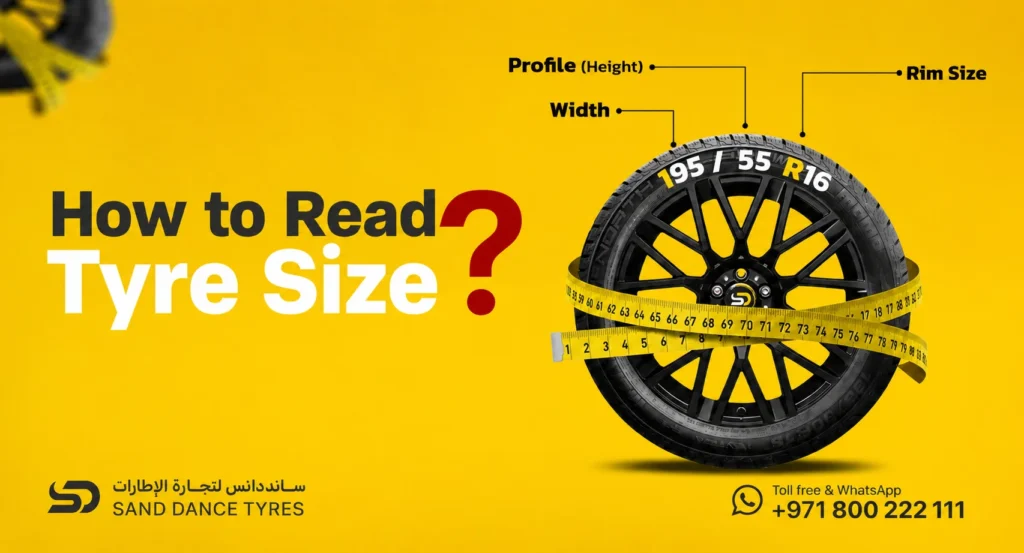
Before breaking down the individual components, it helps to see the full picture. A typical tyre size marking looks something like this:
215/65 R 16 98H
At first glance, this appears to be a random combination of numbers and letters. In reality, it is a precise technical specification. Each part of this code tells you something specific about the tyre’s dimensions and performance characteristics. Let’s decode it piece by piece.
1. The First Number: Tyre Width (215)
The first number in a tyre size — in our example, 215 — represents the tyre width in millimetres. This is the measurement of the tyre from one sidewall to the other when the tyre is properly inflated and mounted on the recommended rim width.
So a tyre marked 215 is 215 mm wide. Common widths range from around 155 mm for small economy cars to 335 mm or more for high-performance sports vehicles. A wider tyre generally provides a larger contact patch with the road, which can improve grip and handling. However, wider tyres can also increase rolling resistance and may affect fuel economy.
When replacing tyres, staying within the manufacturer’s recommended width range is crucial. Going significantly wider than recommended can affect steering precision, cause the tyre to rub against wheel arches, and interfere with safety systems like ABS and stability control.
2. The Second Number: Aspect Ratio (65)
After the slash comes the aspect ratio — in our example, 65. This number represents the tyre’s profile height as a percentage of its width.
Using our example: 65% of 215 mm = approximately 140 mm. This means the sidewall height from the rim to the tread is roughly 140 mm.
A lower aspect ratio (like 35 or 40) means a shorter sidewall — this is what you see on sporty or performance vehicles. Low-profile tyres generally offer sharper handling response because there is less sidewall flex during cornering. However, they are also less forgiving over bumps and potholes, and can be more susceptible to damage from road hazards.
A higher aspect ratio (like 65, 70, or 80) means a taller sidewall. These tyres offer a more comfortable ride, better at absorbing road imperfections, and are commonly found on family cars, SUVs, and light trucks.
Understanding the aspect ratio helps you make informed choices about ride comfort versus handling performance when selecting replacement tyres.
3. The Construction Type: R (Radial)
The letter following the aspect ratio indicates the tyre’s internal construction. In modern tyres, this is almost always R, which stands for Radial.
- R (Radial): The most common type today. Radial tyres have cords running perpendicular (at 90 degrees) to the direction of travel, with additional belt layers beneath the tread. This construction provides better fuel efficiency, improved tread life, enhanced grip, and a more comfortable ride.
- D (Diagonal or Bias-Ply): An older construction where cords run diagonally across the tyre. Occasionally found on older vehicles, motorcycles, and some agricultural or industrial applications.
- B (Belted Bias): A hybrid between radial and diagonal construction, now largely obsolete for passenger vehicles.
For the vast majority of modern cars, the R designation is standard, but it’s good to know what it represents, particularly when sourcing tyres for older or specialty vehicles.
4. The Rim Diameter: 16 (Inches)
The number after the construction letter indicates the diameter of the wheel rim that the tyre is designed to fit — expressed in inches. In our example, 16 means the tyre fits a 16-inch wheel.
Common rim diameters range from 13 inches on older small cars to 22 inches or more on modern SUVs and luxury vehicles. This number is critical — a tyre with the wrong rim diameter simply will not fit on your wheel. There is no room for approximation here; the tyre’s inner diameter must match the wheel diameter exactly.
When upgrading to larger wheels (a practice called “plus sizing”), you typically need to reduce the aspect ratio to keep the overall tyre diameter consistent. This prevents your speedometer from giving inaccurate readings and ensures your vehicle’s suspension geometry remains correct.
5. The Load Index (98)
Moving to the next section of the code, 98 is the load index. This is a numerical code that corresponds to the maximum weight a single tyre can carry when properly inflated.
The load index does not directly express weight — instead, it references a standardised table. For example:
| Load Index | Max Load (kg) |
|---|---|
| 80 | 450 kg |
| 88 | 560 kg |
| 91 | 615 kg |
| 96 | 710 kg |
| 98 | 750 kg |
| 100 | 800 kg |
| 104 | 900 kg |
So a tyre with a load index of 98 can carry up to 750 kg per tyre. For a vehicle with four tyres, that’s a combined maximum of 3,000 kg — sufficient for most passenger vehicles.
Always replace tyres with an equal or higher load index than specified by the vehicle manufacturer. Using a lower load index than recommended is dangerous and may void your insurance in the event of an accident.
6. The Speed Rating (H)
The final letter in a standard tyre size code is the speed rating — in our example, H. This letter indicates the maximum sustained speed the tyre is designed to handle safely.
Here is a reference chart for common speed ratings:
| Rating | Max Speed (km/h) |
|---|---|
| Q | 160 km/h |
| R | 170 km/h |
| S | 180 km/h |
| T | 190 km/h |
| H | 210 km/h |
| V | 240 km/h |
| W | 270 km/h |
| Y | 300 km/h |
| ZR | 240+ km/h |
An H-rated tyre is rated for speeds up to 210 km/h. For most everyday driving conditions, ratings of T, H, or V are appropriate. Performance and sports cars typically require V, W, or Y-rated tyres to match their capabilities.
Just like load index, it is important to never fit tyres with a lower speed rating than recommended by the vehicle manufacturer. Even if you personally never drive at high speeds, a lower-rated tyre may not handle heat buildup and stress as effectively at motorway speeds.
Reading Additional Tyre Markings
Beyond the main size code, your tyre sidewall contains other useful information:
M+S (Mud and Snow)
This marking indicates the tyre is designed for light mud and snow conditions. It is commonly found on all-season tyres. Note that M+S is not the same as a full winter tyre rating.
The Three-Peak Mountain Snowflake (3PMSF)
This symbol — a snowflake inside a mountain — indicates the tyre meets rigorous standards for severe winter conditions. If you live in a region with heavy snowfall, look for this marking rather than just M+S.
DOT Code and Manufacture Date
The Department of Transportation (DOT) code on the tyre includes a four-digit number at the end indicating the week and year of manufacture. For example, 2423 means the tyre was made in the 24th week of 2023. Tyres older than six years should be inspected carefully, and most manufacturers recommend replacement after ten years regardless of tread depth.
Run-Flat Markings
Run-flat tyres carry manufacturer-specific markings such as RFT (Bridgestone), SSR (Continental), ROF (Michelin), or ZP (Goodyear). These tyres can be driven for a limited distance — typically 80 km at up to 80 km/h — after a complete loss of pressure.
XL (Extra Load) or RF (Reinforced)
These markings indicate the tyre has a reinforced structure capable of carrying heavier loads than a standard tyre of the same size. They are common on SUVs, vans, and vehicles that frequently carry heavy loads.
Why Getting Tyre Size Right Matters
Using the correct tyre size is not merely a technical formality — it has real-world consequences:
- Safety: Incorrect tyres can compromise braking distances, handling stability, and resistance to blowouts.
- Legal compliance: In many countries, driving with tyres that do not meet the vehicle’s approved specifications is illegal and can invalidate your insurance.
- Fuel efficiency: The right tyre size ensures optimal rolling resistance, maintaining the fuel economy your vehicle was designed to achieve.
- Speedometer accuracy: An incorrect overall tyre diameter will cause your speedometer to show an inaccurate speed reading, which can result in unintentional speeding.
- ADAS systems: Modern vehicles with advanced driver assistance systems (ADAS) are calibrated for specific tyre dimensions. Wrong sizes can cause these systems to malfunction.
Where to Find Your Correct Tyre Size
If you are unsure what tyre size your vehicle requires, there are several reliable places to check:
- The tyre sidewall itself — your current tyres display the size code clearly.
- The door jamb sticker — most vehicles have a placard on the driver’s door jamb listing the manufacturer-recommended tyre size and inflation pressure.
- The fuel filler cap — some vehicles include tyre information here.
- The owner’s manual — the most comprehensive source for your vehicle’s tyre specifications.
- Tyre manufacturer websites — most have online tools where you enter your vehicle’s make, model, and year to find compatible tyre sizes.
Conclusion
Reading a tyre size is a skill that takes only a few minutes to learn but serves you for a lifetime of car ownership. Once you understand that 215/65 R16 98H breaks down into width, aspect ratio, construction, rim diameter, load index, and speed rating, the sidewall of any tyre becomes easy to read and interpret.
Armed with this knowledge, you can verify that a shop is fitting the right tyres to your vehicle, make informed comparisons when shopping for new tyres, and understand how different tyre specifications affect your ride quality, safety, and performance. Never let tyre purchasing be a guessing game — your safety and the safety of everyone in your vehicle depends on getting it right.